
Christmas Card Mailing Timeline for On-Time Holiday Delivery
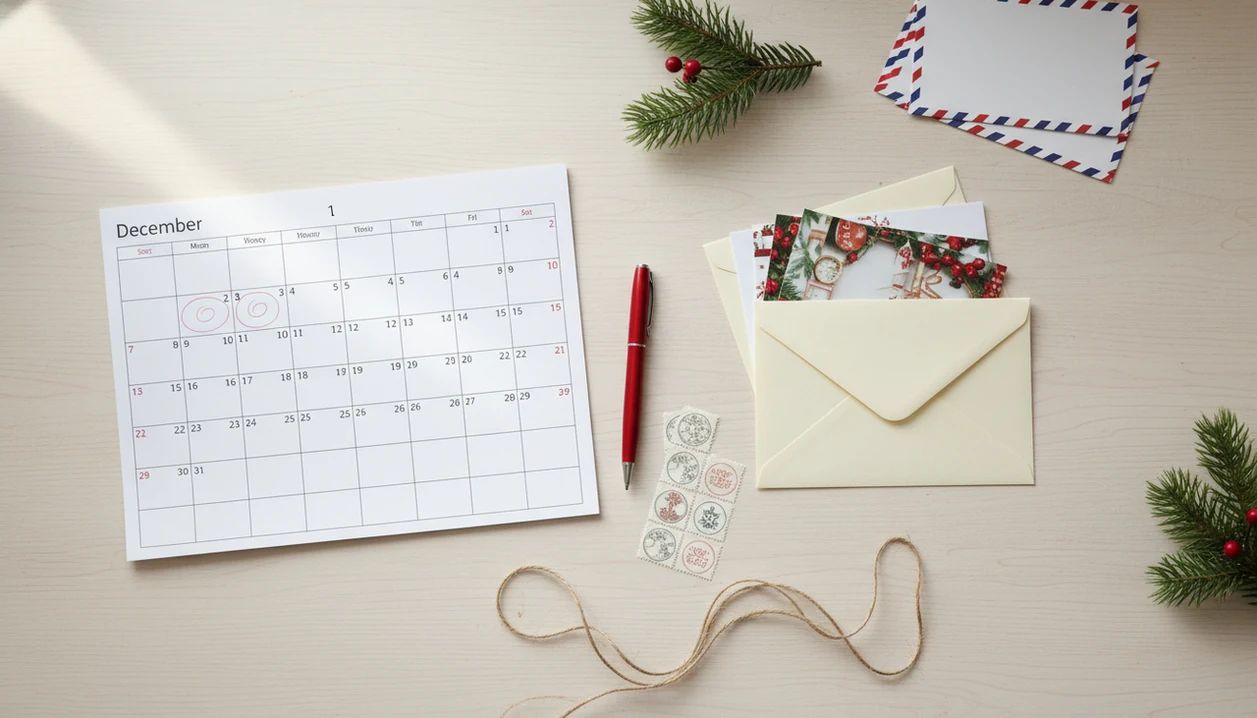
Mail most domestic U.S. Christmas cards between December 1 and December 10. Send international and business cards earlier, and allow extra time for printing, addressing, postage, weekends, weather, and peak holiday volume. Check current postal deadlines each year because delivery estimates and destination-specific cutoffs can change.
> A Christmas card mailing timeline is the backward-planned schedule that takes a card from phone photo selection to printing, addressing, postage, and mailing before the holiday delivery window closes.
TL;DR
- Mail most domestic Christmas cards December 1 to 10 for the best balance of festive timing and delivery buffer.
- Begin photo selection, card design, printing, and envelope prep by early to mid-November if you want physical cards.
- Send international, APO, FPO, and DPO cards earlier, often by mid-November, and use New Year’s cards if you miss the Christmas window.
Christmas Card Mailing Timeline at a Glance
Mail most domestic Christmas cards between December 1 and December 10. That window feels seasonal without leaning too hard on the final postal cutoff.
For international, APO, FPO, and DPO addresses, plan for mid-November or earlier. Those cards should leave first, even if the rest of the envelopes are still in a neat pile beside the stamp sheet stuck to your sleeve.
Back up 2 to 3 weeks from your target mail date for printing, shipping to you, handwriting, labels, and postage checks. A good christmas card maker and holiday greeting guides that help families turn phone photos into printable cards, digital greetings, and festive portraits using ai styles deliver a faster draft, not a postal shortcut.
If you miss the Christmas window, send New Year’s cards. Still thoughtful. Less frantic.
Five Facts About When to Mail Christmas Cards
- Most U.S. Christmas cards should be mailed December 1 to 10. This gives cards time to arrive before Christmas without showing up before the season feels underway.
- Printed cards need a 2 to 3 week runway before mailing. Include photo choice, design approval, printer production, shipping, handwriting, and addressing.
- International and APO/FPO/DPO cards need earlier timelines. USPS holiday guidance shows some international dates can fall 2 to 6 weeks before domestic dates, depending on destination and service.
- Digital greetings can be sent later than physical cards. A digital Christmas greeting card can still feel timely during Christmas week.
- Peak December volume makes buffer days matter. USPS reported it expected more than 10.6 billion mailpieces and packages during the 2023 holiday season in its holiday readiness update: https://about.usps.com/newsroom/national-releases/2023/0919-usps-ready-to-deliver-for-america-during-the-holidays.htm.
How a Christmas Card Mailing Timeline Works
A Christmas card mailing timeline works by choosing the desired arrival date first, then subtracting time for design, printing, shipping to you, envelope prep, and postal transit. The simple model is backward planning: start at Christmas week and count back through every task that can slip.
Postal transit is only one part. Production queue, printer shipping, return-address labels, postage, and address cleanup all sit before the mailbox. December also changes the risk profile because mail volume rises sharply, so a normal 1 to 5 business day First-Class Mail range can feel less forgiving near Christmas.
At 9:47 p.m., with the kids asleep and the phone battery at 18%, the issue is rarely creativity. It’s the calendar. Tools like a Christmas card app can compress the phone-photo-to-card-design step, but they do not remove printing, envelope, or mailing lead time.
How to Use a Christmas Card Mailing Timeline
Use the timeline by setting the delivery goal first, then turning each earlier task into a dated checkpoint. For most families, the schedule is easier when the card draft, stamps, and addresses are not all handled on the same night.
- Set a target arrival date for each group, such as before December 20 for nearby relatives.
- Choose the delivery path for every recipient: domestic, international, military, hand-delivered, or digital.
- Reserve design and printing time in early to mid-November, especially for photo cards.
- Buy stamps and address envelopes early so you are not waiting on postage after cards arrive.
- Mail with a several-day buffer instead of aiming for the last possible USPS date.
- Save a backup digital version for late additions, missing addresses, or weather delays.
For families using one phone photo, a last minute Christmas card maker can help finish the draft faster. The mailing clock still matters.
Before You Start: Christmas Card Mailing Prerequisites
Before you build the mailing timeline, get the list, format, and envelope details settled. The date you choose only works if the card type, recipients, and postage needs are already clear.
- Finalize your address list before picking a mail date, especially if anyone moved, changed names, or added an apartment number.
- Sort your recipients into separate groups for domestic, international, military, hand-delivered, and digital greetings. Each group may need a different deadline.
- Choose your card format before estimating timing. A flat digital greeting, a printed photo card, and a folded card with inserts all create different design, print, and mailing steps.
- Confirm the details early, including photo permission, name spelling, family-name formatting, and whether the card says “The Parkers” or “The Parker Family.”
- Check one complete envelope before buying postage. Include the actual card, any photo strip or note, and the envelope itself so size, weight, thickness, and shape do not surprise you later.
This small prep pass prevents the classic late-night problem: beautiful cards finished, wrong stamp in hand.
Step 1: Set Your Holiday Card Mailing Deadline
When should you set your holiday card mailing deadline? Use December 1 to 10 as the standard domestic U.S. mailing window, then move earlier for faraway, military, and international addresses.
Mailing before Thanksgiving is allowed, but it is usually unnecessary for ordinary U.S. Christmas cards. Cards sent too early can arrive before decorations are up, before school photos are chosen, or before you have the final address from the cousin who moved in October.
The better move is to set two deadlines. Put international and military cards first, then domestic cards in the first third of December. USPS dates vary by service and year, so check the current holiday shipping guidance before you seal the final stack. The missed post office cutoff notice always feels personal.
Step 2: Build Printing and Photo Card Prep Into the Timeline
Select phone photos in late October or early November if you want printed photo cards without a rushed order. The photo does not need to be flawless. Yellow living-room light, a toddler looking away, or a dog leash in the corner may still work if the crop is clean.
Create or approve the holiday card draft by early to mid-November. Then allow time for production, shipping to you, envelope stuffing, and handwriting. A printer delay matters more than a design delay because it blocks every step after it.
AI-styled portraits and ready-to-print templates can shorten design time, especially when your best photo is already on your phone. If wording slows you down, keep a short list of Christmas card wording ideas beside the draft.
Step 3: Address Envelopes, Postage, and USPS Checks
Update mailing addresses before the cards arrive. It is much easier to fix a spreadsheet in early November than to peel off a label after the envelope is sealed.
Buy holiday stamps in early November if you know you are sending standard-size cards. Then check the actual envelope weight, size, thickness, and inserts before mailing. Square cards, heavy cardstock, wax seals, photo strips, and extra notes can change postage. A home inkjet tray pulling cardstock slightly crooked is annoying; underpaid postage is worse.
Separate domestic, international, and military addresses into different piles. That small sorting step prevents the common mistake of treating every envelope the same. Before the final drop, check current USPS holiday dates and service guidance at the official source. Print shops can advise on paper, but USPS sets mailing rules.
Step 4: Adjust the Christmas Card Timeline for International Mail
International and military Christmas cards should not follow the domestic December 1 to 10 schedule. Send them first, even if the domestic envelopes are still waiting for stamps.
| Recipient type | Practical timing | Why it needs attention |
|---|---|---|
| Domestic U.S. | December 1 to 10 | Allows a normal seasonal buffer before Christmas. |
| International First-Class | Often mid-November or earlier | Destination processing and customs can add time. |
| International Priority | Often earlier than domestic mail | USPS holiday dates vary by country and service. |
| APO/FPO/DPO | Often mid-November or earlier | Military mail has routing steps beyond normal domestic delivery. |
USPS holiday guidance shows some international First-Class and Priority deadlines can be weeks earlier than domestic dates. Check the destination-specific date, then mail that batch first. If the grandparent waving from the doorway is on the front of the card, send that copy before you finish the neighborhood stack.
Step 5: Use Digital or New Year’s Cards After the Mailing Window
If the mailing window is gone, switch formats instead of abandoning the greeting. Digital greetings can go closer to Christmas, and New Year’s cards can go out in late December or early January.
- Digital Christmas greeting: Use this when you still want the card to arrive before Christmas Day. A free digital Christmas card maker can help if printing no longer makes sense.
- General holiday card: Use this when the card may arrive after December 25 but still fits the season.
- New Year’s card: Use this for late family photos, delayed business approvals, or January catch-up notes.
- Business holiday message: Use a neutral greeting if offices close before Christmas week.
For small businesses, digital timing can also prevent a rushed print order with old branding or wrong hours. For families, the pajama photo beside the stockings may be the card. That counts.
Common Christmas Card Mailing Timeline Mistakes
The biggest mistake is waiting for the final USPS domestic cutoff instead of mailing during the safer December 1 to 10 window. Final dates are not comfort dates. They are last practical chances, and delays can still happen.
Another common slip is forgetting printer shipping time. Approving a card online does not put envelopes on your table. You still need production, packaging, delivery to you, and time to fix any print issue.
International mail is the third trap. Treating London, Tokyo, an APO address, and the next town as one mailing batch invites missed arrivals. Separate them early.
Postage also causes trouble. If you buy stamps after envelopes are sealed, you may discover that heavy or square cards need more than a standard stamp. Digital and physical timing differ too; a digital card can go Christmas week, but a printed card needs a real runway.
Christmas Card Mailing Verification Checklist
Before mailing, run one final check. It takes ten minutes and prevents most avoidable card problems.
- Confirm recipient names, spellings, and apartment numbers.
- Confirm your return address is present and correct.
- Weigh or verify postage for the actual sealed envelope.
- Separate domestic, international, APO, FPO, and DPO mail.
- Check the crop on the final card before printing extras.
- Photograph or save the final card design.
- Save a backup file, even if it is named final-final-card.pdf.
- Prepare digital backup greetings for late additions.
For iPhone users, the iPhone share sheet makes it easy to send the finished file to a printer, Messages, Mail, or cloud storage. The full phone workflow is covered in how to make Christmas card on iPhone.
Last day to mail Christmas cards (USPS timeline)
For domestic Christmas mailing, aim to send cards by December 10 to 15; the exact last mailing day for Christmas depends on the USPS service, destination, weather, and that year’s published holiday deadlines, so treat the official cutoff as a final delivery estimate rather than a guarantee of arrival by December 25.
Check the current USPS holiday schedule before mailing Christmas cards. Send international, military, and remote-destination cards earlier, often from late November through early December, because customs and local delivery can extend transit times.
When to start printing Christmas cards for on-time delivery
Start printing Christmas cards two to three weeks before your planned mailing date, ideally by mid-to-late November, to allow time for photo review, production, shipping, addressing, postage, and corrections before the busiest Christmas mailing deadlines.
For large orders or custom finishes, add another week. A digital tool such as a Christmas card app can shorten design time, but printed cards still need production and delivery buffers before your chosen last mailing date for Christmas.
Limitations
A Christmas card mailing timeline lowers risk, but it cannot guarantee delivery by a certain day.
- USPS and international postal delays are outside the sender’s control.
- Printing, packing, and shipping require real lead time, even with a fast design tool.
- December 1 to 10 is a typical U.S. recommendation, not a delivery guarantee.
- Weather, labor disruptions, transportation issues, and peak volume can affect arrival dates.
- International and military estimates vary by destination, service, customs, and routing.
- Cheaper or slower mail services add more risk near the holiday card mailing deadline.
- Local print shops, Walgreens, CVS, and online printers may have different production cutoffs.
- AI-styled cards still need a full zoom check for face details before printing.
- Card-making apps such as Canva and Picsart can help create a draft, but postage and carrier timing remain separate decisions.
If timing is already tight, choose the format that matches the calendar. Printed cards usually work best when you have at least 2 to 3 weeks, while digital greetings fit people who need to send a warm note within days.
FAQ
When should I mail Christmas cards?
Mail most domestic U.S. Christmas cards between December 1 and December 10. Add several buffer days if the recipient is far away or your local post office is already busy.
Is December 15 too late to mail Christmas cards?
December 15 may still work for nearby domestic addresses, but the delay risk is higher. It is safer to use digital greetings or New Year’s cards for late or distant recipients.
Can I mail Christmas cards before Thanksgiving?
Yes, you can mail Christmas cards before Thanksgiving. For most domestic U.S. cards, it is usually earlier than necessary.
When should international Christmas cards go out?
International Christmas cards often need to be mailed by mid-November or earlier. Check the destination and mail service because deadlines vary widely.
When should business holiday cards be mailed?
Business holiday cards should usually be mailed earlier than personal cards, often from late November to early December. This helps them arrive before offices close or staff leave for holidays.
When should digital Christmas cards be sent?
Digital Christmas cards can be sent closer to Christmas, including the week of the holiday. They are useful when printing or postal timing is no longer realistic.
Are New Year’s cards acceptable if I miss Christmas?
Yes, New Year’s cards are acceptable if you miss the Christmas mailing window. They work well for late photos, delayed printing, or January family updates.
How long does USPS First-Class Mail take during the holidays?
https://www.usps.com/ship/mail-shipping-services.htm. During the holiday season, peak volume can lengthen transit times, so mail earlier than the final practical cutoff.
Do photo Christmas cards need extra postage?
Photo Christmas cards may need extra postage if they are oversized, square, heavy, thick, or include inserts. Weigh one sealed envelope before mailing the whole stack.