
How to Photograph Pets with Christmas Lights
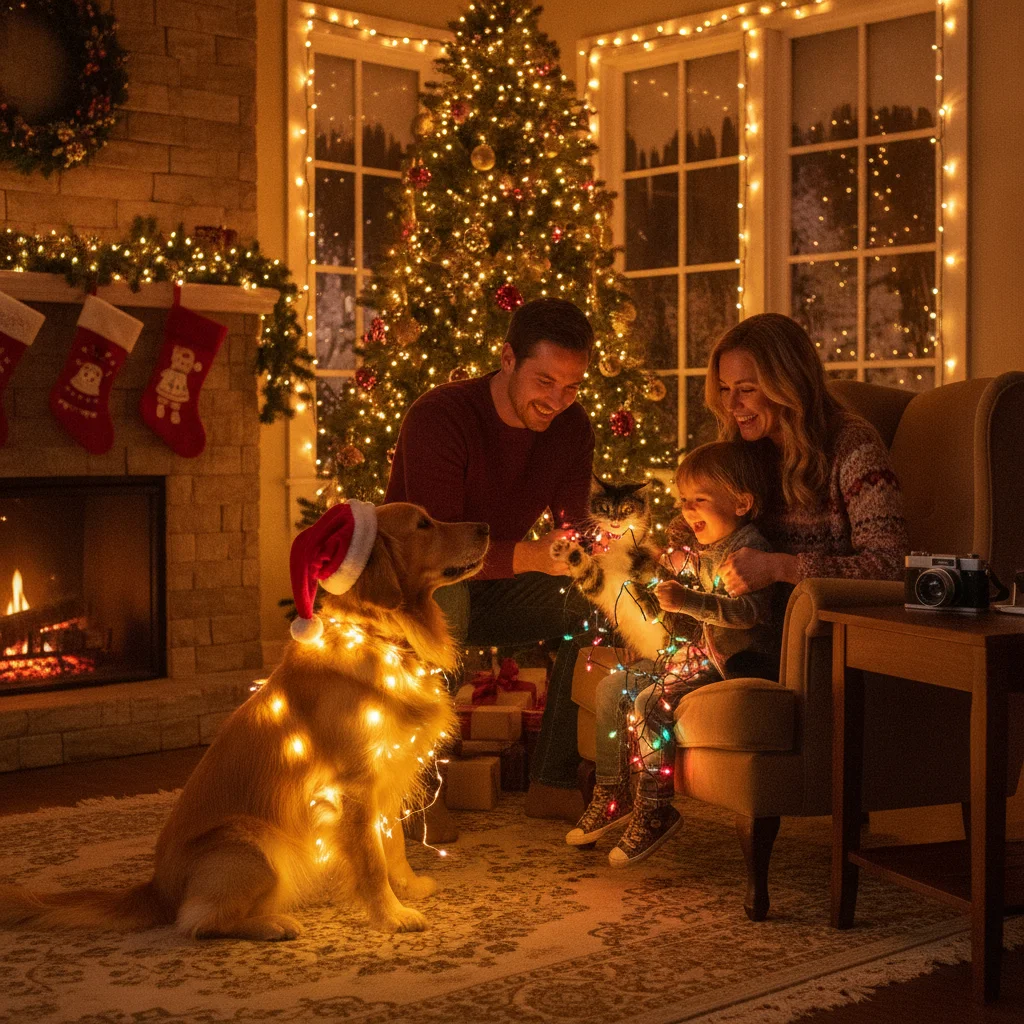
Quick answer: Photograph pets with Christmas lights by using cool-running LED lights in the background, placing the pet near a soft window or lamp, and focusing on the eyes. Use a wide aperture, a shutter speed of at least 1/250 second, and burst mode. Keep wires, ornaments, and lights out of the pet’s reach throughout the session.
Christmas lights can create warm color, soft bokeh, and a festive setting for pet portraits. The main challenge is balancing the dim decorative lights with enough illumination to keep an active pet sharp. A safe arrangement, patient handling, and a few basic camera adjustments can produce better results than an elaborate set.
How should you arrange Christmas lights around a pet?
Place Christmas lights behind the pet rather than wrapping them around the animal. A distance of 3 to 8 feet between the pet and the lights helps individual bulbs turn into soft circles when the camera uses a wide aperture.
Use battery-powered or low-voltage LED lights when possible. LED bulbs stay cooler than traditional incandescent bulbs, but wires and battery packs still need to remain out of reach. Secure cables against a wall or behind furniture so the pet cannot chew, pull, or become tangled in them.
Choose a simple background such as a plain wall, a neutral blanket, or a Christmas tree. Too many ornaments and reflective decorations can distract from the pet’s face.
What lighting makes both the pet and Christmas lights visible?
Christmas string lights usually cannot illuminate a pet’s face on their own. Position the pet near a window, a shaded floor lamp, or a soft LED panel. Place the main light slightly to one side of the camera so the eyes show clear catchlights.
Avoid direct on-camera flash because it can cause harsh shadows, red-eye, and an unnatural difference between the pet and the background. If flash is necessary, bounce it from a white ceiling or wall. Never fire a powerful flash repeatedly close to an animal’s face.
Which camera settings work best for pet Christmas photos?
| Setting | Suggested starting point | Purpose |
|---|---|---|
| Shutter speed | 1/250 to 1/500 second | Reduces blur from head and body movement |
| Aperture | f/1.8 to f/4 | Creates background bokeh while keeping the face clear |
| ISO | 800 to 3200 | Compensates for low indoor light |
| Focus mode | Continuous autofocus with animal eye detection | Tracks movement and prioritizes the eyes |
| Drive mode | Short continuous bursts | Captures brief expressions and still moments |
These settings are starting points rather than fixed rules. Increase ISO before choosing a shutter speed that is too slow. A slightly grainy sharp photograph usually looks better than a clean but blurry image.
How do you keep a pet’s eyes in focus?
Set the focus point on the eye closest to the camera. Animal eye detection is useful, but check that the camera has not selected a shiny ornament or bright bulb instead.
For pets with long noses, use f/2.8 to f/4 if both eyes and the nose need to appear sharp. When photographing two pets, position their eyes on roughly the same plane and consider f/4 to f/5.6.
How can you get natural expressions without forcing a pose?
Photograph the pet at eye level and keep sessions short. Use familiar treats, a quiet toy, or a known command to guide the pet toward the chosen spot. Ask a helper to stand close to the camera and attract the pet’s attention.
Capture several types of expression rather than waiting for a single perfect pose. A head tilt, yawn, nose lick, or glance toward the lights can feel more natural than a rigid sit. Stop if the pet walks away repeatedly, pants from stress, flattens its ears, or hides.
How can you improve color and bokeh?
Move the pet farther from the lights and move the camera closer to the pet to make the bokeh appear larger. A longer focal length, such as 50mm to 85mm on a full-frame camera, can also strengthen background blur.
Set white balance between approximately 3200K and 4500K for warm indoor lights, then adjust based on skin, fur, and decoration colors. Photograph in RAW format when available because mixed window light and decorative bulbs can create difficult color casts.
What safety precautions should you follow?
- Do not wrap powered lights around a pet’s neck, legs, or body.
- Keep glass bulbs, hooks, tinsel, batteries, and electrical connections out of reach.
- Supervise the pet during the entire setup and unplug lights immediately afterward.
- Use non-slip flooring so the pet can sit or stand comfortably.
- Avoid candles, artificial snow, toxic plants, and breakable ornaments.
- Let the pet inspect unfamiliar props before photography begins.
What limitations should you expect?
Very dark rooms may require a high ISO, which can add visible noise. Wide apertures can also leave part of a pet’s face out of focus, especially at close range. Phone cameras may brighten the scene automatically and reduce the glow of Christmas lights.
Some pets will not remain still near decorations. In that case, photograph the pet in a comfortable location and keep the lights farther behind. A calm, safe portrait is more valuable than a complicated setup that causes stress.
The most reliable approach is a simple background, soft light on the pet’s face, Christmas lights several feet behind, and a fast shutter speed. Prioritize the pet’s comfort and eyes, then use distance and aperture to create the festive effect.
How can you photograph pets with Christmas lights without stressing them?
To photograph pets with Christmas lights without causing stress, let the animal approach the setup voluntarily and take pictures during brief, reward-based intervals. Arrange the scene before bringing the pet in, secure cords out of reach, and provide a familiar bed or blanket away from hot, flashing, or dangling decorations. Begin with the room lights on so the space feels normal, then adjust the lighting gradually while watching the pet’s body language. Use treats, toys, or a familiar person near the camera instead of repeatedly repositioning the animal. Keep an open escape route and stop if the pet hides, pants, flattens its ears, tucks its tail, or refuses rewards. There is no universal stress-free session length because tolerance varies by animal; several short attempts are safer than pushing for one finished portrait.
The most common failure is selecting a Christmas-lights photo in which the pet looks stressed
The most common failure in a pet-and-Christmas-lights card is choosing the sharpest frame even though the pet looks stressed. Spot it in the final crop by checking for pinned ears, whale eye, repeated lip licking, a tucked tail, crouching, panting unrelated to heat, or an attempt to leave. Treats should reward calm pauses rather than keep the animal staring, drooling, or lunging toward the camera. A festive coat can also change the expression; remove it if the pet freezes, scratches, bites at the fabric, or becomes warm. Before sending the card, enlarge the exact print crop and compare the face and posture with a familiar relaxed photo. Reject the image if the lights look appealing but the pet’s discomfort is what viewers will notice first.
Frequently asked questions
Can Christmas lights provide enough light for a pet portrait?
Christmas lights are usually too dim to light a pet clearly. Add soft window light, a lamp, or a diffused LED panel while keeping the decorative lights visible in the background.
What shutter speed should I use for pet Christmas photos?
Start at 1/250 second for a calm pet and increase to 1/500 second or faster for active movement. Raise ISO if the image becomes too dark.
How do I make Christmas lights look blurry behind my pet?
Place the lights several feet behind the pet and use a wide aperture such as f/1.8 to f/2.8. Moving closer to the pet or using a longer focal length will make the light circles appear larger.
Are LED Christmas lights safe around pets?
Cool-running LED lights are generally safer than hot incandescent bulbs, but cords, batteries, and bulbs can still be hazardous. Keep all lighting equipment out of reach and supervise the pet continuously.
Can I use a phone to photograph pets with Christmas lights?
A phone can work well when the pet’s face has extra soft light and the background lights are several feet away. Use portrait mode carefully because it may blur whiskers, ears, or fur edges.
Should I use flash for a Christmas pet portrait?
Soft bounced flash can freeze motion without overpowering the Christmas lights. Avoid direct flash close to the pet’s face and stop if the animal appears uncomfortable.
How long should a pet photography session last?
Use short sessions of about 5 to 10 minutes, with breaks as needed. End the session when the pet shows stress, avoids the set, or loses interest in rewards.
What should I do if my pet will not sit near Christmas lights?
Do not force your pet to sit near the lights. Increase the distance, place the pet on a familiar mat, and reward any calm attention toward the setup. You can also move the lights farther into the background and use a longer focal length so they remain visible without requiring the animal to approach them.
How can I tell when my pet needs a break from holiday photos?
Your pet needs a break when its behavior changes from relaxed to avoidant or restless. Watch for turning away, lip licking, yawning, pinned ears, a tucked tail, panting, pacing, hiding, or refusing favorite treats. End the attempt calmly and allow the animal to leave rather than trying one more pose.
Should I use treats while photographing my pet with Christmas lights?
Yes, use small, familiar treats if your pet stays calm around food. Give them between brief sets or have a helper hold one near the lens, then lower it before exposure so the eyes do not track upward. Stop if treats cause barking, jumping, guarding, drooling, or frantic focus; a toy or quiet praise may produce a more natural expression.