
Christmas Card Printing and Mailing
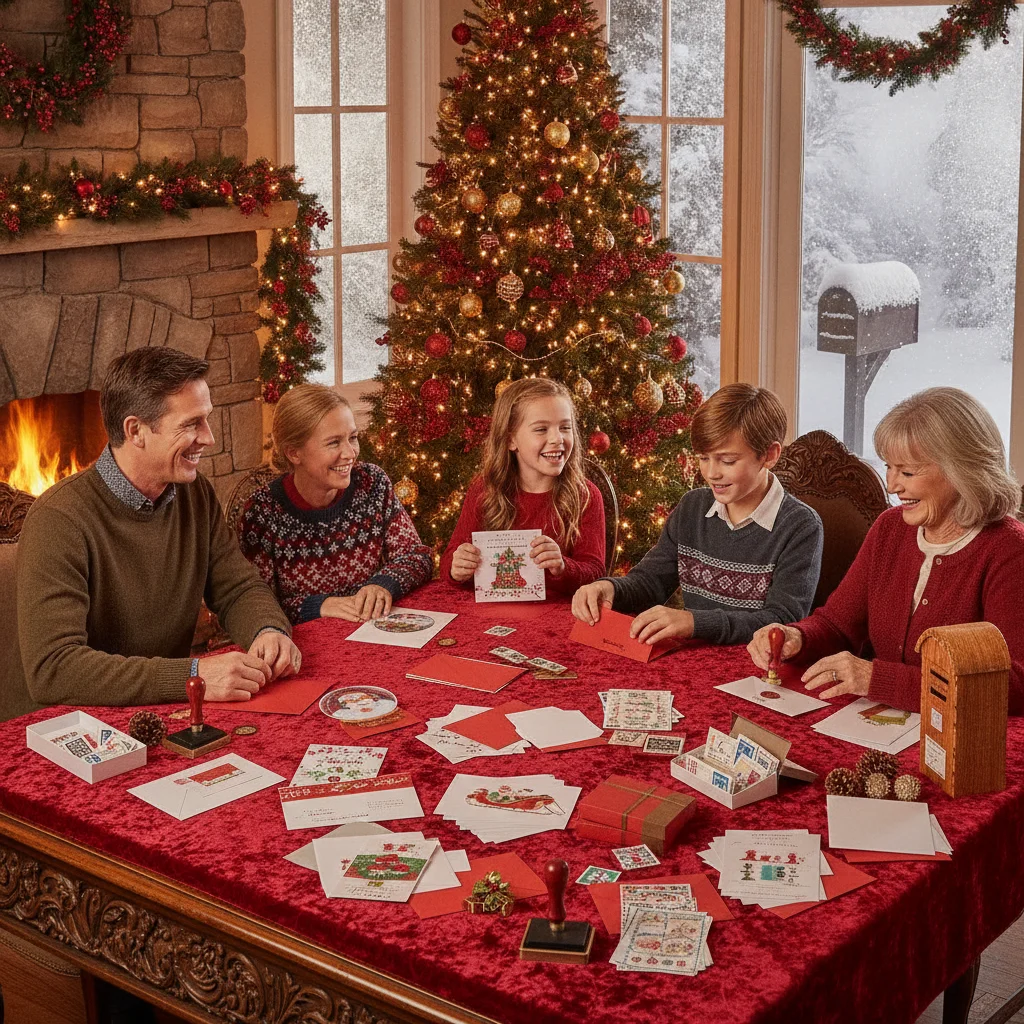
Quick answer: Christmas card printing and mailing can be handled at home, split between a printer and the sender, or completed by a full-service card company. The best choice depends on quantity, budget, design control, handwriting preferences, and deadlines. Order samples, verify every address, review a printed proof, and confirm current postal requirements before approving the full order.
Christmas card printing and mailing involves more than choosing a festive template. A finished card must reproduce photos clearly, fit its envelope, meet postal rules, reach the correct address, and arrive before the holiday. Each decision affects the total price and the amount of work required.
According to the Greeting Card Association, U.S. consumers purchase 6.5 billion greeting cards annually, including about 1.5 billion Christmas card purchases. A 2024 Vistaprint survey also reported that 61% of respondents preferred printed holiday cards over digital cards, while 45% considered photo quality and clarity important.
This independent guide explains how to compare home printing, local print shops, online printers, and services that print, address, stamp, and mail cards for customers. It also covers files, paper, envelopes, postage, schedules, proofs, and common limitations.
How does Christmas card printing and mailing work?
The process begins with a recipient list and a card design. The design is supplied as a print-ready file or created with a printer's online editor. The printer produces the cards, pairs them with envelopes, and either ships the package to the customer or sends each card directly to its recipient.
There are three common fulfillment methods. Home fulfillment gives the sender control over handwriting, personal notes, envelope stuffing, and the mailing date. Split fulfillment assigns printing to a professional service but leaves addressing and mailing to the sender. Full-service fulfillment assigns printing, addressing, postage, and postal entry to one company.
Full-service mailing usually requires an uploaded address spreadsheet. The provider standardizes the data, prints each destination address, applies postage, and transfers the completed mailpieces to a postal carrier. Some services permit a different message or return address for each household, but personalization options vary.
A card mailed by a provider may not pass through the sender's hands. Careful proofreading is therefore more important than it is with a box of cards delivered home.
Which printing and mailing option should you choose?
The right option depends on card quantity, available time, desired paper, and how much personal handling matters. Home printing can suit a short list, especially when the sender already owns a capable photo printer. Professional printing is usually more consistent for larger batches and folded cards.
| Method | Best for | Main advantage | Main drawback |
|---|---|---|---|
| Print and mail at home | Small lists and handwritten messages | Maximum control over every card | Requires ink, supplies, setup, and labor |
| Local print shop | People who want personal assistance | Paper samples and local proof review may be available | Mailing services and templates may be limited |
| Online printer, ship to sender | Medium or large lists | Broad choice of formats, finishes, and quantities | The sender must address, stuff, stamp, and mail cards |
| Full-service print and mail provider | Busy households, businesses, and large lists | Minimal manual fulfillment | Less opportunity to inspect or handwrite each piece |
Calculate the complete cost rather than comparing the advertised card price alone. The total may include cards, envelopes, return-address printing, recipient addressing, upgraded paper, foil, rounded corners, proofs, shipping, postage, and mailing-service fees.
Minimum quantities also matter. A low unit price may apply only to a large order. Small batches can be less expensive through a local store or home printer even when the per-card production cost looks higher.
If the design still needs a family image, review the planning ideas in christmas photos before selecting the card format.
How should a Christmas card file be prepared for printing?
Start with the printer's exact template. A nominal 5-by-7-inch card may require extra image area around every trimmed edge. This extra area is called bleed. Important faces, names, and text should remain inside the template's safe zone because trimming can shift slightly.
Use the highest-resolution original photo available. Images downloaded from social media, copied from a message thread, or captured as screenshots may look acceptable on a phone but print with visible compression or softness. Many printers flag low-resolution files, but an automated warning cannot assess focus, facial detail, or an overly dark exposure.
Photo cards generally reproduce best when images are prepared near the printer's requested resolution, often 300 pixels per inch at final size. Enlarging a small file does not restore missing detail. A 1500-by-2100-pixel image, for example, is a practical target for a 5-by-7-inch print at 300 pixels per inch.
Designers should also expect differences between a lit screen and printed paper. Screens emit light, while paper reflects it. Very dark shadows, subtle gray text, and highly saturated colors may reproduce differently. Requesting a physical proof is the most reliable way to judge the result.
Export text-heavy designs as a print-ready PDF when the printer accepts it. Embed fonts or convert approved text to outlines. Use high-quality JPEG files only when the provider specifically requests a flat image. Additional layout guidance is available in the christmas card design.
Which paper, size, and finish are best for mailed Christmas cards?
Cardstock should be chosen for both appearance and writing. Glossy or coated paper can make photographs look crisp, but some pens smear on the coated surface. Matte and uncoated stocks are usually easier to sign. A printer's sample kit can reveal color, texture, thickness, and writing behavior more accurately than an online preview.
Flat cards are economical and easy to display. Folded cards provide more room for a printed message, handwritten note, or several photographs. Postcards may reduce envelope work, but an exposed postcard offers less privacy and gives the design less protection during sorting.
Standard rectangular dimensions tend to be simpler and less expensive to mail. Square cards, rigid materials, unusually thick pieces, clasps, and bulky decorations can trigger special handling or nonmachinable charges. A decorative element that looks attractive in a mockup may cause trouble in automated postal equipment.
Foil, letterpress, die cuts, painted edges, and premium paper can increase production time. These upgrades should be approved earlier than standard digital printing, particularly during the seasonal order rush.
How should a Christmas card address list be organized?
Use a spreadsheet with separate fields for the recipient name, company if applicable, street address, apartment or unit, city, state, postal code, and country. Separate fields make sorting, correction, and provider uploads easier. Do not place notes such as “new address” in a field that will be printed.
Review duplicate households, recent moves, name changes, military addresses, and deceased recipients before submitting the list. Decide whether couples, children, roommates, and families should be named individually or as a household. Consistent naming prevents awkward differences between envelopes.
Postal address validation can identify some formatting problems, but it cannot prove that a person still lives at an address. Confirm uncertain records directly. Returned mail is usually more expensive and disappointing than a short verification message.
Full-service providers may retain uploaded contacts for reorders. Read the provider's privacy and deletion policies before sharing a personal or business list. Use a unique account password and limit spreadsheet access to people who need it.
Senders handling cards themselves can print addresses directly on envelopes, use labels, or write them by hand. Test printer alignment on a spare envelope first. Dark ink on a light, nonreflective background is easiest for people and postal equipment to read.
When should Christmas cards be ordered and mailed?
Work backward from the preferred arrival date. The schedule must account for design approval, proof production, printing, shipping to the sender, signing, addressing, postage, and postal transit. Full-service orders eliminate shipping to the sender but still require production and postal processing.
Begin address cleanup and photo selection in October or early November when possible. Approve custom or premium printing earlier than basic cards. If cards will be signed by several family members or employees, reserve multiple days for that step rather than treating it as a single evening task.
Domestic cards are commonly mailed in early December, but the correct date depends on the postal product, origin, destination, weather, and current carrier guidance. International, military, and diplomatic addresses often need substantially more time. Check the carrier's official holiday schedule for the current season instead of relying on a deadline from an old article or social post.
A delivery estimate is not a guarantee unless the selected service expressly provides one. Peak demand, severe weather, address errors, customs review, and transportation disruptions can delay a correctly mailed card.
Late senders have several reasonable choices. They can select faster production and shipping, send a New Year card, use a locally printed design, or send a digital greeting while a printed card is in transit. Clear wording such as “Warm wishes for the season” remains appropriate after December 25.
How much postage does a Christmas card require?
Postage depends on destination, size, shape, thickness, flexibility, weight, and mail class. A typical lightweight rectangular card in a standard envelope may qualify for ordinary letter pricing. An oversized, square, rigid, lumpy, or unusually thick card may not.
Weigh the fully assembled mailpiece, including the card, envelope, inserts, stickers, and any decoration. Measuring an empty envelope or an unsigned sample can produce the wrong result. Kitchen scales may help with an estimate, but a postal counter can confirm uncertain pieces.
Never assume that one stamp is sufficient because a previous card looked similar. Postal prices and requirements change. Consult the current official rate table or bring a finished sample to the postal carrier before purchasing stamps for the whole list.
International cards need destination-specific postage and should include the country name on the final address line. Ordinary correspondence generally does not require a customs form, but merchandise, gifts, and other contents can create different requirements.
What should be checked before approving the full print run?
Order one printed proof when timing and budget allow. Inspect it in daylight and normal indoor light. Check skin tones, shadow detail, spelling, punctuation, trim position, fold alignment, paper choice, finish, and whether a preferred pen dries without smearing.
Proof every line as displayed, not as remembered. Confirm the year if it appears, family names, children's names, business titles, website addresses, and return-address details. Ask another person to review the card because the designer often reads the intended wording rather than the printed wording.
For full-service mailing, generate a small test export of the address file. Check apartment placement, capitalization, long family names, blank fields, international formats, and duplicate rows. Confirm how the provider handles incomplete or rejected addresses.
Save the final design, recipient list, order confirmation, proof approval, and mailing receipt. A clean archive makes reorders easier and provides a record if cards are damaged, misprinted, or omitted.
What are the limitations of printing and mailing services?
Online previews cannot show exact paper texture, foil reflection, ink density, or trim variation. Printed colors will not match every phone, monitor, or home printer. Minor cutting and folding differences are normal within a printer's stated tolerances.
Full-service providers reduce manual work but also reduce direct oversight. The sender may be unable to inspect individual cards, add handwritten notes, or correct an address after the mailing file enters production. Cancellation windows can be short.
Delivery dates remain estimates for many postal products. A printer's mailing date is not the same as the recipient's delivery date. International cards face additional uncertainty from transportation and local postal systems.
Survey findings should also be read in context. Vistaprint's 2024 consumer research reported strong interest in printed holiday cards, but vendor-sponsored surveys do not represent every household or market. The Greeting Card Association's annual figures describe the wider U.S. card category rather than the cost or delivery performance of a specific service.
What is the simplest Christmas card mailing checklist?
- Finalize the recipient list and confirm uncertain addresses.
- Select a standard card size unless a special format justifies extra postage.
- Use original, high-resolution photographs.
- Build the design with the printer's bleed and safe-zone template.
- Compare total prices, including envelopes, shipping, services, and postage.
- Order samples or a printed proof.
- Proofread the card and test the address spreadsheet.
- Assemble and weigh one complete mailpiece.
- Confirm current postal rates and seasonal mailing guidance.
- Save final files, receipts, and the corrected list for future cards.
Verdict: Printing professionally and mailing at home offers the best balance for senders who want reliable print quality and handwritten notes. Full-service printing and mailing is usually the practical choice for large lists or limited time, provided the design and address data receive a careful final review.
For wording help before placing an order, see the christmas card messages.
All printing mailing guides
- Adding Photo Inserts Without Exceeding Christmas Card Envelope Thickness Limits
- Best Cardstock for Printing Christmas Cards at Home
- Best Christmas Card Printing Services for Quality, Value and Speed
- Best Envelope Paper Weight for Photo Christmas Cards
- Best Free Printable Christmas Cards PDF: Top Sources
- Best Holiday Card Printing: How to Choose the Right Service
- Cheapest Way to Mail 100+ Christmas Cards: Bulk Postage Tips
- Christmas Card Mailing List Spreadsheet Template
- Christmas Card Printing and Mailing Checklist
- Christmas Card Return Address Etiquette: Printed vs Handwritten
- Eco-Friendly Christmas Card Paper and Envelope Options
- Home Printing vs Costco Christmas Cards: Cost Per Card
- How to Add Return Addresses to Christmas Card Envelopes
- How to Address Christmas Card Envelopes for International Mail
- How to Address International Christmas Card Envelopes
- How to Avoid Non-Machinable Surcharges on Christmas Cards
- How to Batch Print, Sign, Stuff, Stamp, and Mail Christmas Cards
- How to Calculate Postage for Christmas Cards
- How to Choose Christmas Card Envelopes for Fit and Mailing
- How to Choose Matte, Glossy, or Lustre Paper for Photo Christmas Cards
- How to Compare Home and Professional Christmas Card Printing Costs
- How to Determine Whether International Christmas Cards Need Customs Forms
- How to Mail Christmas Cards at the Last Minute
- How to Mail Christmas Cards with Gift Cards Inside Safely
- How to Mail Handmade Christmas Cards With Embellishments
- How to Order Christmas Card Printing From a Print Shop
- How to Print and Mail Christmas Postcards Without Envelopes
- Mail Christmas Cards With Wax Seals Without Extra Postage
- Mailing Christmas Cards to Military APO/FPO Addresses: Deadlines and Requirements
- Matte vs Glossy vs Luster for Christmas Cards
- Postage for Square, Oversized, and Odd-Shaped Christmas Cards
- Ultimate Christmas Card Mailing Checklist and Printable Timeline
How much does Christmas card printing and mailing cost?
The total cost depends on quantity, card size, paper, finish, envelopes, addressing, postage, and whether a provider mails the cards. Compare quotes using the same specifications and include setup fees, printed return addresses, recipient addressing, proofs, extra cards, shipping to you, and postage. Home printing may be economical for a short list when equipment is already available, but ink, paper, envelopes, test sheets, and time still count. Full-service mailing generally costs more per card but reduces assembly work. Before ordering, request an itemized total and confirm whether postage is included or charged later at the current postal rate.
Frequently asked questions
How early should Christmas cards be printed?
Order standard Christmas cards at least several weeks before the preferred mailing date. Add more time for premium finishes, custom shapes, large quantities, address processing, or international delivery. Build in time to review a proof and correct any color, text, image, or address problems before production begins.
Can a company print, address, stamp, and mail Christmas cards?
Yes, full-service providers can print cards, address envelopes, apply postage, and submit completed mail pieces to the postal system. Services vary, so confirm whether the quoted price includes recipient addressing, return addresses, envelope insertion, sealing, postage, proofs, address corrections, and mailing documentation.
Is it cheaper to print Christmas cards at home?
Home printing can cost less for a small quantity when a suitable printer and supplies are already available. Compare the full cost of ink, card stock, envelopes, test sheets, trimming, mistakes, postage, and personal time. Professional printing may offer a lower per-card cost as the quantity increases.
Do square Christmas cards need extra postage?
Square Christmas card envelopes commonly require extra postage because they may be classified as nonmachinable in the United States. The final charge depends on current postal rules, dimensions, thickness, rigidity, and weight. Confirm the assembled envelope with the postal carrier before buying stamps or approving a large print run.
What resolution should a Christmas card photo have?
Use an image that provides about 300 pixels per inch at the final printed size. For a 5-by-7-inch card, that is about 1500 by 2100 pixels (Snaptosize, 2026). Start with the original camera file because screenshots, messaging copies, and social-media downloads may be compressed.
Can Christmas cards be mailed internationally?
Yes, Christmas cards can be mailed internationally with destination-specific postage and a correctly formatted address. Allow more transit time than for domestic mail, verify the destination country's addressing conventions, and confirm whether inserts or enclosed items create customs requirements. Return addresses should also follow the postal carrier's recommended format.
What file format is best for printing Christmas cards?
PDF is usually the best format for a print-ready card because it preserves layout, fonts, and dimensions reliably. A high-resolution JPG can work for a flattened photo design. Before uploading, confirm the printer's requirements for color profile, bleed, crop marks, embedded fonts, file size, and page orientation.
How much postage does a Christmas card require?
The required postage depends on the sealed card's size, shape, thickness, rigidity, weight, and destination. A standard rectangular envelope may qualify for the regular letter rate, while square, oversized, heavy, or rigid pieces may cost more. Check current postal rates after assembling a complete sample with every planned insert.