
Cinematic Christmas Portrait Inspiration
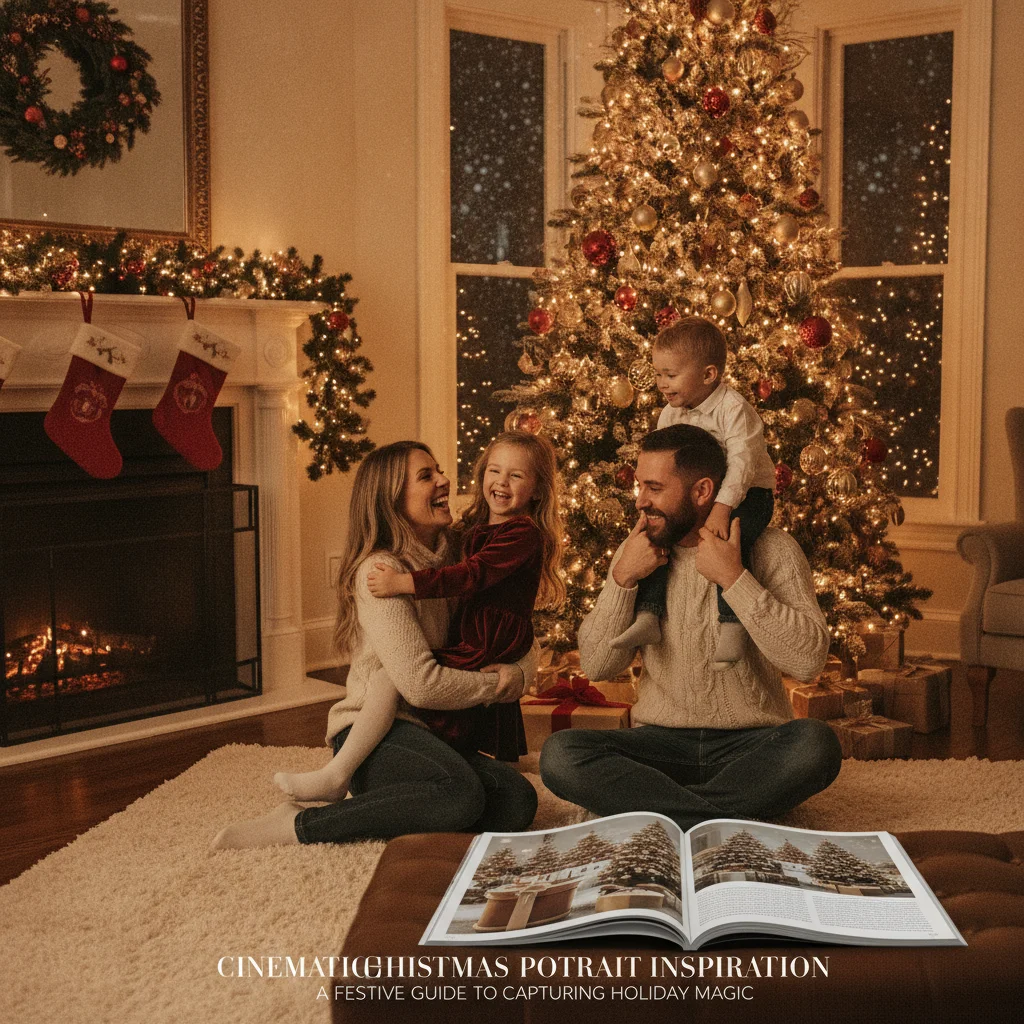
Quick answer: Cinematic Christmas portraits combine directional lighting, deliberate composition, expressive posing, and controlled holiday colors to resemble stills from a film. Use practical lights such as lamps or Christmas bulbs, expose for the subject’s face, add depth through foreground objects, and apply restrained color grading. A simple story or emotion makes the final portrait feel more cinematic.
Cinematic Christmas portraits look like individual frames taken from a holiday film. Instead of relying on a bright backdrop and a standard smile, these portraits use light, color, composition, and expression to suggest a larger story.
The approach works for individual portraits, couples, children, families, and pets. It can be created with a dedicated camera or a recent smartphone, provided that the photographer controls the available light and gives the subject clear direction.
Best approach: Choose one emotional idea, use a dominant light source, keep the background darker than the subject, and include only a few recognizable Christmas details.
What makes a Christmas portrait look cinematic?
A cinematic portrait has visual intention. Every light, color, prop, and facial expression supports the mood of the scene. A photograph of someone reading beside a softly lit tree may suggest comfort, while a portrait near a rainy window can feel reflective or mysterious.
Depth also helps distinguish cinematic images from ordinary snapshots. Place blurred Christmas lights, a doorway, tree branches, or another object near the camera. These foreground elements create layers between the viewer, subject, and background.
Wide compositions can establish the location, while close portraits capture emotion. Photograph both versions during the same session so the resulting set feels like a short visual sequence.
Which lighting creates a holiday film look?
Begin with one clear source of light. Window light, a shaded lamp, a fireplace, or a small LED panel can illuminate the face. Christmas tree lights are usually too dim to serve as the main source, but they work well as glowing background details.
Place the primary light about 45 degrees to one side of the subject. This creates gentle facial shadows and more dimension than direct front lighting. Turn off bright ceiling fixtures, which often produce flat illumination and mixed color temperatures.
For a darker scene, expose for the highlights on the face and allow some areas to fall into shadow. Check that the eyes and important facial details remain visible. A white wall or inexpensive reflector can return a small amount of light to the shadowed side.
Which colors and settings work best?
A limited palette usually looks more controlled than a room filled with competing decorations. Choose two or three main colors, such as deep red and amber, forest green and gold, or icy blue and silver.
| Mood | Color palette | Suggested setting |
|---|---|---|
| Warm and nostalgic | Amber, red, brown | Tree, fireplace, wooden room |
| Quiet and reflective | Blue, gray, soft gold | Window, porch, snowy street |
| Classic holiday drama | Green, burgundy, gold | Dining room or decorated hall |
| Modern winter story | White, silver, cool blue | Minimal interior or outdoor scene |
Wardrobe should fit the palette without perfectly matching the decorations. Textured sweaters, velvet dresses, wool coats, scarves, and tailored dark clothing photograph well. Avoid tiny patterns and large logos because they can distract from the face.
How should subjects pose for cinematic portraits?
Give subjects an action rather than asking them to hold a pose. A person can light a candle, adjust an ornament, wrap a gift, look through a window, or carry a stack of old holiday books. Small actions produce more natural hands and expressions.
Ask couples or families to look at each other before looking at the camera. Quiet glances, shared laughter, and pauses often feel more believable than continuous smiling. For children, build the scene around an activity and photograph from their eye level.
Leave negative space in the direction a subject is looking. A centered composition can feel formal, while placing the face near one side of the frame creates tension and provides room for environmental details.
Which camera settings help preserve the atmosphere?
Use a wide aperture, such as f/1.8 to f/2.8, for one person and a narrower aperture, such as f/4 to f/5.6, for groups. Select a shutter speed fast enough to prevent motion blur, especially when photographing children or handheld scenes.
A higher ISO is often preferable to an underexposed face. Modern cameras can retain useful detail at ISO 800, 1600, or above. Smartphone users should tap the face to set focus and lower the exposure slightly if holiday lights appear as blank white spots.
Portrait mode can simulate shallow depth, but inspect hair, glasses, ornaments, and hands for inaccurate edge separation. A standard camera mode may look more convincing when the background already has natural distance from the subject.
How should cinematic Christmas portraits be edited?
Start by correcting exposure and white balance. Preserve warm practical lights without making skin excessively orange. Reduce bright highlights, deepen blacks carefully, and add moderate contrast around the face.
Color grading should support the original lighting rather than replace it. Warm highlights with slightly cooler shadows can create a familiar film-inspired contrast. Fine grain, restrained vignetting, and a subtle crop may help, but heavy filters can damage skin tones and ornament detail.
For people who prefer quick mobile treatments, Christmas Pictures App: PiXmas is one editorial option available on the Apple App Store. ChristmasCard.io is an independent publication and is not affiliated with PiXmas or its developer.
What are the limitations of the cinematic style?
Low-light portraits can introduce noise, missed focus, and motion blur. Very shallow depth of field may leave family members out of focus, while strong color grading can make skin look unnatural.
Artificial snow, candles, fireplaces, and outdoor winter locations also require safety planning. Keep flames away from clothing and decorations, protect cameras from condensation, and do not leave children or pets unattended near props.
The cinematic approach may not suit every recipient. Capture several brighter, direct portraits alongside the dramatic images so the session also provides clear photographs for cards, prints, and family archives.
What usually goes wrong with cinematic Christmas card portraits?
Cinematic Christmas card portraits usually fail when the scene is made too dark, visually crowded, or dependent on effects that obscure the people. There is no universal exposure or editing preset that guarantees a film-like result, because room lighting, skin tones, decorations, and camera behavior vary.
- Relying only on tree lights can leave faces muddy while bulbs lose detail.
- Mixing cool window light with warm lamps can create uneven skin color.
- Using extremely shallow focus may leave family members in different rows blurry.
- Heavy teal-and-orange grading can overpower natural holiday colors and skin tones.
- Composing like a widescreen movie frame can place faces or key decorations outside the card crop.
- Too many props can make the portrait resemble a set rather than a believable moment.
Frequently asked questions
What is a cinematic Christmas portrait?
A cinematic Christmas portrait uses deliberate lighting, composition, color, and expression to resemble a frame from a holiday film.
Can cinematic Christmas portraits be taken with a phone?
A recent phone can create cinematic portraits when the subject has sufficient directional light and the background is kept at a useful distance.
What is the best lens for cinematic holiday portraits?
A 35mm or 50mm lens works well for environmental portraits, while an 85mm lens creates tighter portraits with strong background separation.
Should Christmas tree lights illuminate the subject?
Christmas tree lights usually work best as background accents because they are rarely bright enough to illuminate a face clearly.
Which clothing looks cinematic in Christmas photos?
Velvet, wool, knitwear, tailored coats, and other textured fabrics work well when their colors support the scene's limited palette.
How can Christmas portraits look cinematic without appearing too dark?
Expose carefully for the face, preserve detail in the eyes, and use a reflector or nearby wall to soften deep shadows.
Why do my cinematic Christmas portraits look artificial?
Cinematic Christmas portraits often look artificial when every element appears staged or heavily processed. Keep one clear source of visual interest, allow natural variations in posture, and use decorations as context rather than filling every empty area. Reduce strong color grading if skin, greenery, and warm lights no longer look believable together.
How do I make a group Christmas portrait feel like a movie scene?
Build the group portrait around a small shared action rather than asking everyone to face the camera identically. Arrange people at slightly different depths, but keep their eyes within the lens’s usable focus range. Side lighting, restrained expressions, and a visible holiday environment can suggest a film scene without sacrificing recognizable faces.