
Matte vs Glossy vs Luster: Which Paper Finish Is Best for Christmas Cards?
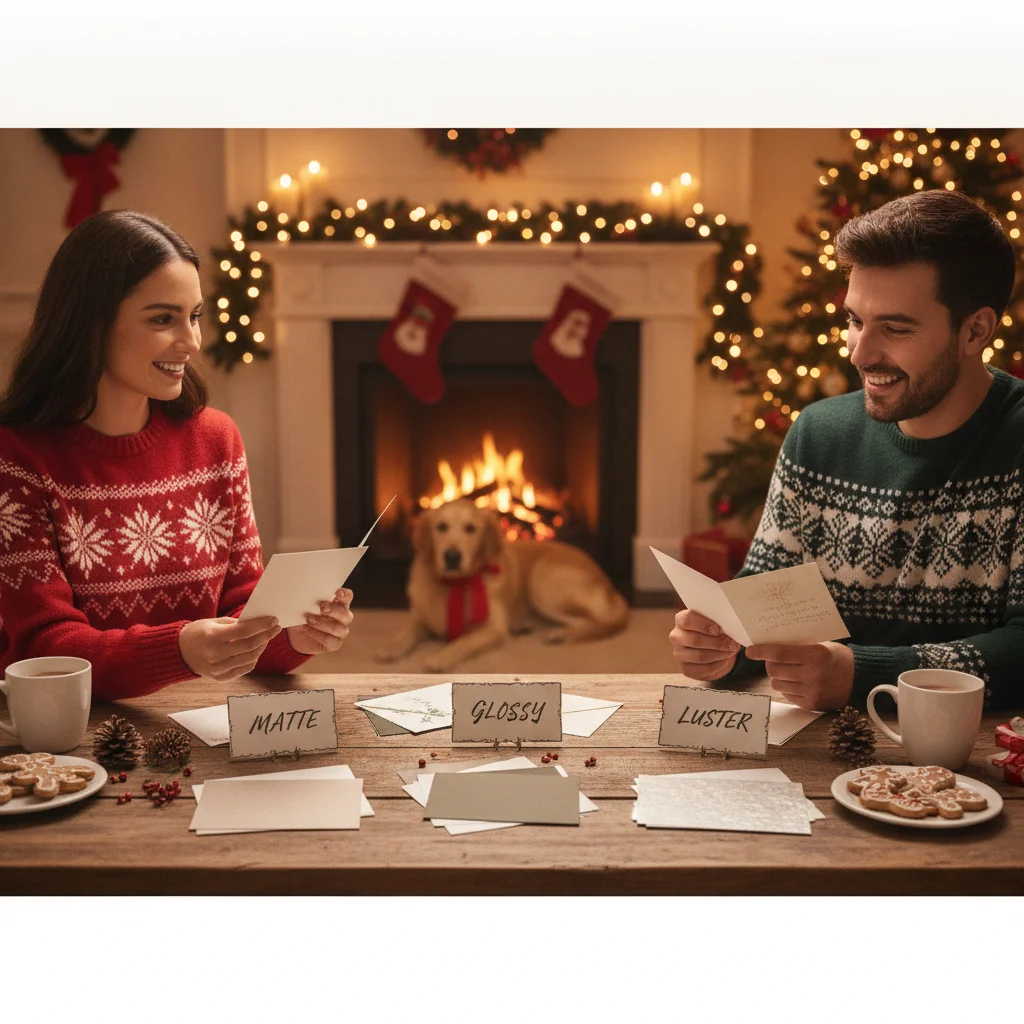
Quick answer: Matte is best for handwritten messages and an understated look, glossy produces the richest color and sharpest photos, and luster offers the best overall balance. For most photo Christmas cards, luster is the safest choice because it preserves color and detail while reducing glare, fingerprints, and writing problems.
The best finish for a Christmas card depends on whether the card is primarily a photograph, a handwritten greeting, or a mix of both. Finish affects color, glare, texture, fingerprints, and how easily recipients can write on or display the card.
Matte works especially well for folded greetings and text-focused designs. Glossy suits bold photographic cards. Luster, sometimes called pearl or satin, sits between the two and is often the most practical choice for family photo cards.
How do matte, glossy, and luster Christmas card finishes compare?
| Finish | Appearance | Best for | Main drawback |
|---|---|---|---|
| Matte | Soft, low-reflection surface | Handwriting, illustrations, text-heavy cards | Colors may look less intense |
| Glossy | Shiny, highly reflective surface | Colorful photos and high-contrast designs | Shows glare and fingerprints |
| Luster | Subtle sheen with light texture | Photo cards that also include a message | Not always easy to write on |
These descriptions are general. Printers use terms such as luster, lustre, satin, pearl, and semi-gloss differently, so the exact surface can vary by supplier.
When is matte the best finish for Christmas cards?
Choose matte when recipients need to read substantial text or when you plan to sign every card by hand. Its low-reflection surface stays legible under lamps and near windows, making it a strong option for long family updates, religious messages, illustrated cards, and minimalist typography.
Many pens write more reliably on matte stock than on coated glossy paper. Ballpoint, gel, and felt-tip performance still depends on the coating, so test the actual card before signing a large batch. An uncoated matte interior is usually the easiest writing surface for folded cards.
Matte can soften contrast and deep blacks. That subdued appearance may suit warm portraits and muted designs, but it can make highly saturated decorations or dark nighttime photos look less punchy.
When is glossy the best finish for Christmas cards?
Glossy is a good choice when the photograph is the main attraction. The reflective coating can make reds, greens, deep shadows, and fine details appear richer and sharper. It works particularly well for single-image postcards, snowy landscapes, colorful decorations, and studio portraits.
The tradeoff is handling. Glossy cards can show fingerprints, and direct light may create glare that obscures part of the image. The coating can also resist common pens or cause ink to smear. If a glossy card needs a personal note, use an uncoated back or select a folded format with a writable interior.
Why is luster often best for photo Christmas cards?
Luster provides much of the color depth associated with glossy printing without a mirror-like shine. Its lightly textured surface diffuses reflections, hides fingerprints better, and preserves strong photo detail. These qualities make luster suitable for family portraits that recipients may display on a refrigerator, shelf, or card holder.
Luster is the most balanced option when a design includes both photography and short printed text. It is less subdued than matte and less reflective than glossy. However, a coated luster surface may still be difficult to sign, so cards with personal messages benefit from a separate matte writing area.
Does the printer or card format affect the right finish?
Professional photo labs generally produce more consistent glossy and luster finishes than typical home printers. If printing at home, confirm that the paper coating is compatible with an inkjet or laser printer. Using the wrong coated stock can cause poor ink adhesion, smearing, curling, or inaccurate color.
Postcards need a writable and mail-friendly reverse side. Folded cards can use a photo finish outside and an uncoated surface inside. Flat cards with writing on the front usually work best in matte, while a full-bleed photograph generally benefits from luster or glossy stock.
How should you choose a finish for your specific design?
- Start with the main content. Select matte for text or handwriting, glossy for maximum photo impact, and luster for a mixed design.
- Consider the lighting. Matte and luster reduce distracting reflections in brightly lit rooms.
- Plan where you will sign. Request an uncoated writing area if the chosen photo finish resists ink.
- Order a proof. Check skin tones, dark areas, small text, glare, and pen performance before purchasing the full quantity.
Verdict: Luster is the best all-purpose finish for most photo Christmas cards. Matte is better for handwriting and understated artwork, while glossy is best when vivid photographic color matters more than glare or pen compatibility.
What are the limitations of comparing paper finishes?
Finish names are not standardized across printing companies. One supplier’s satin finish may resemble another supplier’s luster or semi-gloss option. Paper weight, coating, ink, printer calibration, and image quality can also change the final appearance.
Online previews cannot accurately reproduce surface reflection or texture. A physical sample pack or printed proof is the most reliable way to compare finishes, especially for dark photos, delicate skin tones, metallic-looking graphics, or cards that must be signed by hand.
The overlooked print specification for matte, glossy, and luster Christmas cards
The print specification people most often skip when choosing a Christmas card finish is whether the coating is applied to one side or both. Selecting “glossy” or “luster” does not necessarily reveal how the back or folded interior will be treated. For a photo card, a coated front paired with an uncoated back can preserve image contrast while leaving a practical surface for signatures and notes. On folded cards, confirm whether the selected finish covers only the exterior or also the writing area inside. Ask the printer to identify the coating configuration, exact stock, and writable surfaces before ordering. Finish names alone cannot predict the result because production options and terminology vary among printers; a physical sample or small proof is the most reliable way to evaluate the complete combination.
Does your Christmas card finish cover the writing side too?
The most common finish-specification failure is ordering a coating for both sides when the design needs a writable back or interior. This happens when “glossy” or “luster” is selected without confirming whether the printer applies it to the photo side only or to every printed surface. Spot the problem before submission by reading the product specification and order summary for “front only,” “both sides,” “coated back,” or “uncoated interior.” Then check a physical sample with the exact pen intended for signatures; an on-screen proof cannot show whether ink will bead or smear. If no sample is available, choose a front-only finish and leave the message surface uncoated.
Frequently asked questions
Is matte or glossy better for Christmas cards?
Matte is better for handwriting and easy reading, while glossy is better for vivid photographs. The right choice depends on whether the message or image is the main focus.
What is the best finish for family photo Christmas cards?
Luster is usually the best finish for family photo cards because it combines strong color and detail with reduced glare and fingerprint visibility.
Can you write on glossy Christmas cards?
Glossy coatings can resist ink and cause smearing. Use an uncoated back or interior, or test a permanent pen and allow the ink to dry fully.
Does matte paper make photos look dull?
Matte paper can reduce saturation, contrast, and deep-black intensity compared with glossy paper. A well-adjusted image can still look detailed and professional on matte stock.
Are luster and satin finishes the same?
Luster and satin both describe low-sheen photo surfaces, but printers do not use the terms consistently. Physical samples provide the most accurate comparison.
Which Christmas card finish shows the fewest fingerprints?
Matte generally shows the fewest fingerprints, with luster close behind. Glossy surfaces are the most likely to display handling marks.
Should folded Christmas cards use different finishes inside and outside?
A photo coating outside and an uncoated matte surface inside is a practical combination. It gives the cover strong image quality while keeping the message area easy to write on.
Can Christmas cards have different finishes on the front and back?
Yes, some Christmas cards can have a coated front and an uncoated or matte back. This combination suits photo-led designs that need stronger color on the front but space for handwritten notes on the reverse. Availability depends on the printer, stock, and card format, so verify the coating configuration before placing the full order.
Which paper finish works best for dark Christmas card designs?
Luster or glossy paper often gives dark Christmas card designs deeper-looking blacks and stronger contrast than matte paper. However, glossy surfaces can introduce reflections that obscure fine text, while luster reduces some glare. If the design combines a dark photograph with small lettering, compare a printed proof under typical indoor lighting before choosing.
Should Christmas cards have a glossy front and matte back?
Yes, this combination is often practical when the front is photo-led and the back carries a handwritten message. The glossy face can strengthen contrast, while an uncoated or matte back accepts common pens more reliably. Confirm that the printer offers split finishes; selecting glossy may otherwise coat both sides, depending on the product.