
How Do You Choose Envelopes for Christmas Cards?
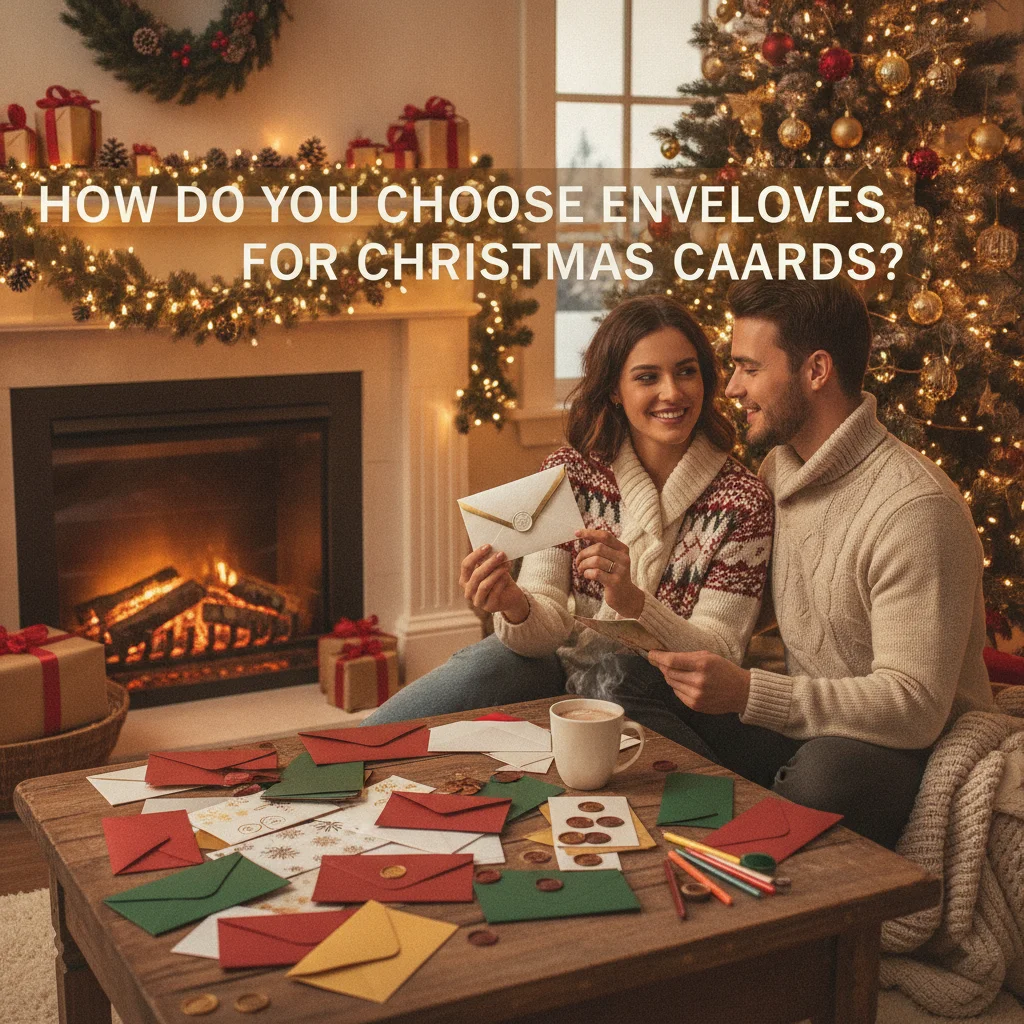
Quick answer: Choose an envelope that is slightly larger than the finished card, leaving enough clearance for easy insertion without excessive movement. Match the paper weight and finish to the card, check that addresses remain readable, and consider postal rules for square, rigid, thick, or embellished mail. Test one fully assembled card before ordering or mailing the complete batch.
The right Christmas card envelope protects the card, supports the design, and avoids preventable mailing problems. Start with the card's finished dimensions, then evaluate clearance, paper weight, color, texture, closure, and postal compatibility. An attractive envelope is useful only if the card fits comfortably and the postal service can process it correctly.
How should you measure a Christmas card for an envelope?
Measure the finished card after folding, not the flat sheet before folding. Record the width and height with the card closed. If the card contains photos, layered paper, ribbon, inserts, or raised decorations, measure the total thickness as well.
Envelope dimensions normally describe the envelope itself, but sellers may list either exterior or interior measurements. Read the product specifications before ordering. Manufacturing tolerances and thick envelope seams can reduce usable interior space.
| Finished card size | Common envelope choice | Fit notes |
|---|---|---|
| 4.25 × 5.5 inches | A2, about 4.375 × 5.75 inches | Close fit for a standard folded note card |
| 4.5 × 6.25 inches | A6, about 4.75 × 6.5 inches | Allows moderate insertion clearance |
| 5 × 7 inches | A7, about 5.25 × 7.25 inches | Common choice for photo Christmas cards |
| 5 × 5 inches | About 5.5 × 5.5 inches | Square shape may require extra postage |
Envelope names and dimensions can vary by manufacturer. Treat common size labels as a starting point and confirm the listed measurements.
How much space should the envelope have around the card?
A practical envelope usually provides about one-eighth to one-quarter inch of clearance on each side. A snug fit creates a tailored appearance, but a fit that is too tight can bend corners, catch on layers, or make hand assembly frustrating.
Allow more space when the card has multiple inserts or raised details. Avoid choosing a much larger envelope because the card may slide, arrive with damaged edges, or look mismatched. A paper insert or belly band can also change the required clearance.
Which envelope paper weight works best?
The envelope should feel substantial enough to protect the card without becoming unnecessarily rigid. Medium-weight text or writing paper is suitable for many flat holiday cards. Heavier cards, photo cards, and layered designs benefit from a stronger envelope that resists tearing and shows less of the contents.
Paper opacity matters with photographs and dark printing. Hold a sample against the assembled card under bright light. If the design or message is visible through the envelope, choose a darker color, a heavier stock, or a lined envelope.
Does envelope color and finish affect addressing?
White, cream, kraft, and pale colors provide strong contrast for handwriting and printed addresses. Dark red, green, navy, metallic, or glossy envelopes can be harder for people and postal equipment to read.
Use an opaque address label or a light printable area when selecting a dark envelope. Test pens before addressing the batch because coated and metallic surfaces may cause ink to smear. Matte and uncoated papers generally accept handwriting more reliably than slick finishes.
A liner can add color and conceal the card, but it also increases thickness. Coordinate the liner with the card rather than relying on an exact color match, since paper texture and lighting can change how colors appear.
Which envelope shapes are easiest to mail?
Rectangular envelopes are usually the simplest choice for standard letter processing. In the United States, a machinable letter generally needs a rectangular shape and a length-to-height ratio between 1.3 and 2.5. Square envelopes fall outside that ratio and commonly receive a nonmachinable surcharge.
Thickness, rigidity, clasps, uneven contents, and bulky embellishments can also affect postage or processing. A card with a wax seal, bow, wooden ornament, or thick decoration may need hand cancellation, extra postage, protective packaging, or parcel treatment. Postal rules differ by country and can change, so confirm current requirements locally.
Which envelope closure should you choose?
Traditional gummed flaps are economical for large quantities, although sealing many by hand takes time. Peel-and-seal strips are faster and reduce moisture-related mess. Reusable closures are less common for mailed Christmas cards and may interfere with processing if they include clasps or bulky components.
Check the flap after inserting the card. An overfilled envelope can place tension on the adhesive and open during transit. For older stock, test the adhesive because humidity and storage conditions can weaken the seal.
How can you test envelopes before buying a full pack?
Order a sample when possible. Insert the finished card and every planned enclosure, seal the envelope, write or print an address, and let the ink dry. Check the corners, opacity, flap tension, total thickness, and finished weight.
Take one fully assembled sample to a postal counter if its shape, weight, flexibility, or decoration may create a surcharge. A physical review is more reliable than estimating postage from the empty envelope.
What limitations should you consider?
Common envelope size names are not perfectly standardized, and paper thickness can change the usable interior dimensions. Postal acceptance also depends on the completed mailpiece rather than the envelope alone. Home printers have different paper-feed limits, so a printable envelope should be tested in the exact printer that will address it.
For most Christmas cards, choose a rectangular envelope with modest clearance, readable address contrast, reliable adhesive, and enough strength for the completed card. Confirm the fit and postage with one assembled sample before preparing the full mailing.
How do mailing and postage rules affect envelope choice for Christmas cards?
Mailing and postage rules change how you choose envelopes for Christmas cards because the packed piece—not just the envelope—must meet size, shape, thickness, flexibility, and weight requirements. Before buying envelopes, assemble one finished card with every insert, photo, liner, or embellishment and have that exact sample evaluated at the post office. A rigid mailer, bulky knot, clasp, or uneven decoration can shift a letter into a different postage or handling category. Choose a plain rectangular envelope when predictable letter-rate processing matters, and reserve padded or reinforced envelopes for cards that genuinely need protection. Do not rely on the package’s nominal envelope size to calculate postage. Exact postage cannot be determined from dimensions alone; the destination, final weight, construction, and current postal rules also matter.
Who needs to check postage before choosing Christmas card envelopes?
This page helps new parents mailing thick photo announcements, teachers sending many cards, clients whose cards must arrive before office closures, and renters who need a reliable return address before choosing Christmas card envelopes. Interfaith families using one mailing for several seasonal greetings also benefit because envelope weight, rigidity, and shape—not the wording inside—can affect postage and processing.
Before ordering, weigh a fully assembled sample with every insert, then confirm that its dimensions and flexibility qualify for the intended mail class. Allow time to replace envelopes or change the design if the sample requires special handling. People who will hand-deliver every card can ignore the postage checks, although they should still test fit and closure. Anyone using a standard flexible rectangular envelope with a previously tested card can focus mainly on fit and legible addressing.
Frequently asked questions
What size envelope fits a 5 × 7 Christmas card?
An A7 envelope measuring about 5.25 × 7.25 inches commonly fits a 5 × 7 card. Confirm the manufacturer's interior dimensions if the card is thick or layered.
Should a card envelope be the exact same size as the card?
No. The envelope needs slight clearance so the card can be inserted without bending corners or straining the seams.
Do square Christmas card envelopes cost more to mail?
Square envelopes commonly require a nonmachinable surcharge in the United States. Current rates and rules should be confirmed with the applicable postal service.
Can dark envelopes be mailed?
Dark envelopes can be mailed, but the delivery and return addresses need strong contrast. A light, opaque address label is often the most readable option.
Are lined envelopes worth using for Christmas cards?
Lined envelopes add opacity and a decorative finish. The liner also adds thickness, so the assembled envelope should be checked for fit and postage.
Can Christmas card envelopes go through a home printer?
Many can, but the result depends on envelope thickness, flap construction, finish, and the printer's feed path. Test one envelope using the printer manufacturer's recommended settings.
Do wax seals require extra postage?
Wax seals may make an envelope uneven, rigid, or nonmachinable, which can require extra postage or special handling. Ask the local postal service to inspect a finished sample.
Should I weigh a Christmas card in its envelope?
Yes. Weigh the fully assembled card inside its sealed envelope, including liners, photos, gift cards, and decorations. The finished piece is what postal equipment and pricing rules assess. If your scale is imprecise near a rate boundary, ask a postal clerk to verify it before mailing the batch.
Does a ribbon inside a Christmas card affect postage?
It can. A ribbon, knot, button, or layered insert may create uneven thickness or make the envelope too rigid for standard automated processing. Place the complete card in the envelope and check whether it remains uniformly flat and flexible; if not, use protective packaging and request a postage assessment.
Should I weigh a Christmas card with the envelope?
Yes, weigh the finished card inside its envelope. Include liners, extra photos, inserts, ribbons, stickers, or other pieces that will be mailed. Check more than one sample if materials vary. The assembled weight and thickness, rather than the card alone, determine whether your planned postage is sufficient.