
How to Include a Photo Insert in a Christmas Card Envelope Without Exceeding Thickness Limits
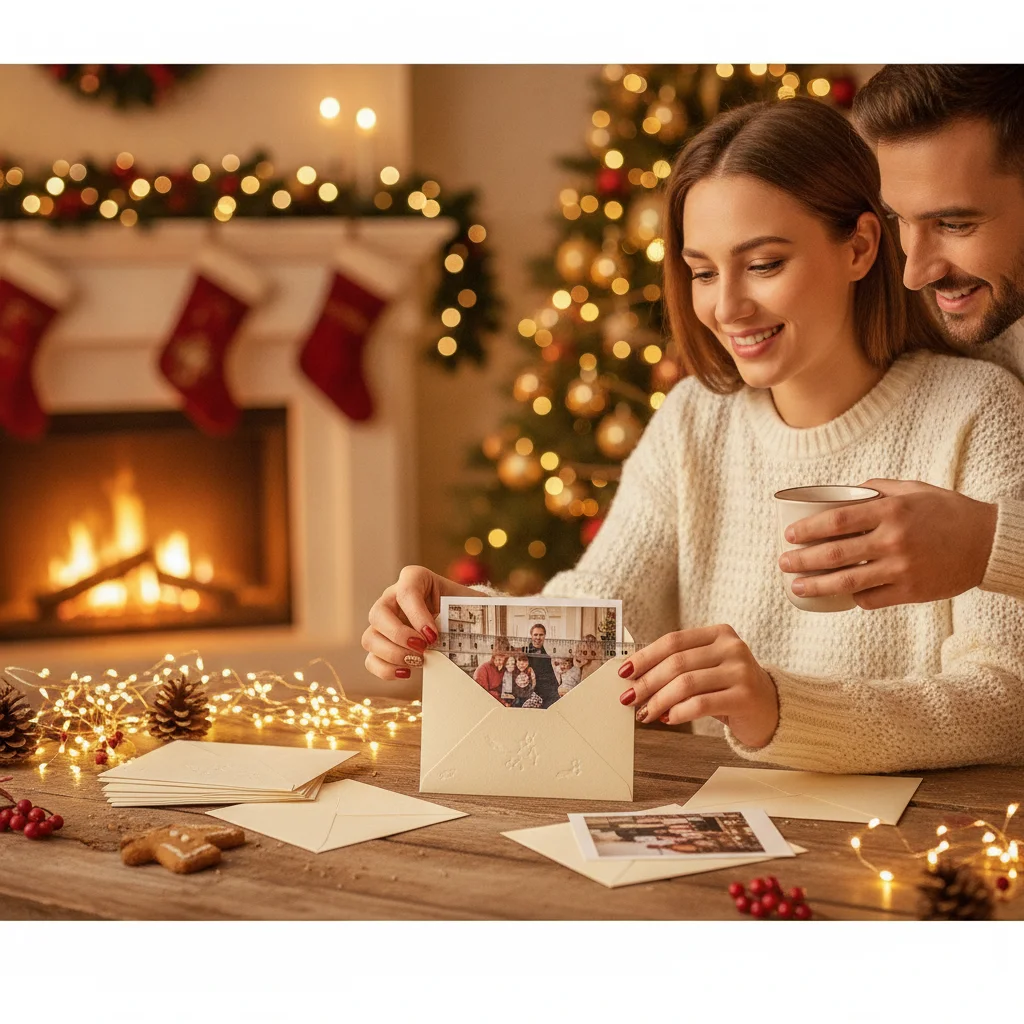
Quick answer: Place one unmounted photo inside the fold of the Christmas card, avoid bulky sleeves or clips, and measure the sealed envelope at its thickest point. For USPS domestic letter pricing, the finished piece generally cannot exceed 1/4 inch thick and must remain flexible and reasonably even. Ask a postal clerk to verify borderline or rigid envelopes before mailing.
What thickness limit applies to a Christmas card with a photo insert?
For USPS domestic mail, an envelope sent at letter rates generally cannot be more than 1/4 inch thick. The complete mailpiece counts toward that measurement, including the envelope, folded card, photo, adhesive, decorative elements, and any protective material.
Thickness is not the only factor. A letter must also meet applicable length, height, flexibility, shape, and uniform-thickness standards. A Christmas card that is under 1/4 inch may still require a nonmachinable surcharge if it is square, unusually rigid, lumpy, or difficult for postal equipment to process.
A photo print by itself is usually thin. Problems are more likely when several photos, a folded newsletter, a plastic sleeve, foam adhesive, ribbon, or a raised ornament are placed in the same envelope.
| Mailpiece characteristic | General USPS letter guidance |
|---|---|
| Maximum thickness | 1/4 inch |
| Maximum length | 11 1/2 inches |
| Maximum height | 6 1/8 inches |
| Shape | Rectangular for standard machinable processing |
| Construction | Flexible and reasonably uniform in thickness |
Which type of photo insert keeps the envelope thinnest?
Choose a standard photo print without a cardboard mount, magnetic backing, frame, or protective case. One 4-by-6-inch print usually fits inside many folded Christmas cards while adding very little bulk.
Matte and glossy prints are both suitable. The finish has less effect on mailing thickness than the number of inserts and the materials used to hold them in place.
If the photo is smaller than the card, position it near the center of the fold. This placement distributes the thickness rather than creating a hard edge near one side of the envelope.
Avoid stacking multiple photos in exactly the same position. If two prints are necessary, offset them slightly while keeping both within the card. Check that the resulting envelope remains flat rather than developing a noticeable ridge.
How should you assemble the card and photo?
Open the Christmas card and place the photo against the inside panel. Keep the print fully within the card edges so it cannot catch during insertion.
Use photo corners, a small piece of thin double-sided photo-safe tape, or no adhesive at all. Thick adhesive dots and foam mounting squares can create a nonuniform lump.
Close the card and insert it into the envelope with the folded edge first. This reduces the chance of the photo shifting or scraping against the envelope flap.
Add any letter or newsletter as a flat, unfolded sheet when its size permits. If folding is required, avoid placing every fold directly over the photo.
Seal one completed sample before preparing the full batch. The sealed sample should include every item that recipients will receive.
Do not use paper clips, binder clips, staples, or rigid photo protectors. Metal fasteners and hard plastic components can affect flexibility, sorting, and postage classification.
How do you measure the finished envelope correctly?
Measure the sealed envelope at its thickest point without pressing or compressing it. A ruler can provide a rough check, but a thickness gauge or caliper is more useful when the piece is close to 1/4 inch.
Gently flex the finished envelope in both directions. A typical paper greeting card should bend without significant force. If the card behaves like a rigid board, it may not qualify for ordinary machinable letter processing even when its measured thickness is below the maximum.
Run your fingers across the envelope to identify abrupt changes in thickness. Relocate the photo or folded enclosure if one area feels much thicker than the rest.
What should you do if the envelope is close to the limit?
Take a fully assembled sample to a post office before buying postage for the entire mailing. A postal clerk can evaluate its dimensions, flexibility, shape, and thickness and determine whether additional postage or another mail class applies.
Do not assume that adding an extra stamp resolves every issue. Postage depends on the mailpiece classification, weight, dimensions, and machinability. An envelope thicker than the letter limit is not automatically accepted as a large envelope if it is too rigid or otherwise fails the applicable standards.
The safest setup is one unmounted photo inside a flexible rectangular card, with the sealed envelope comfortably below 1/4 inch rather than exactly at the limit.
What limitations should you consider before mailing?
The measurements above describe general USPS domestic letter standards. International mail and postal operators outside the United States use different size, thickness, and pricing rules.
Postal requirements and rates can change. Unusual handmade cards, wax seals, buttons, bows, wood pieces, and layered decorations need individual assessment because thickness alone does not determine eligibility.
Home rulers and calipers may also produce small measurement differences. When an envelope is near a threshold, an in-person postal check is more reliable than estimating from the thickness of the photo and card separately.
How postage classification affects a Christmas card with a photo insert
Postage for a Christmas card with a photo insert is determined by the sealed envelope’s final shape, flexibility, weight, and thickness—not by the photo alone. A thin insert can still change processing if it creates a stiff area or a noticeable ridge. Keep the photo flat between the card’s panels, position it away from layered embellishments, and avoid clips, sleeves, or folded notes that concentrate bulk in one spot. Seal one complete envelope, then check its thickest point and whether the piece bends evenly. If the envelope is irregular or rigid, it may require different handling or a different mail category rather than ordinary letter postage. There is no reliable fixed postage amount without the finished piece’s measurements and weight; ask a postal clerk to classify a sample before preparing the full batch.
Why Can a Thin Christmas Card With a Photo Insert Still Need Different Postage?
The most common failure is treating the thickness check as the entire postage check. A photo insert can keep the envelope under the thickness ceiling while the finished piece is overweight, square, unusually rigid, or uneven enough to fall outside ordinary letter pricing or processing. Spot this before mailing by assembling one complete sample with the card, photo, note, sleeve, and sealed envelope exactly as recipients will receive it. Weigh that sample on a scale that reads small increments, then inspect its overall dimensions, flexibility, and profile from every edge. If the photo slides, tape or corner pockets create a ridge, reposition the insert or take the finished sample to a postal counter for classification.
Frequently asked questions
Can I put a 4-by-6 photo inside a Christmas card?
Yes. A single unmounted 4-by-6 photo fits inside many standard folded Christmas cards and usually adds little thickness.
What is the maximum USPS thickness for a letter envelope?
A USPS domestic letter generally cannot exceed 1/4 inch in thickness. It must also satisfy size, shape, flexibility, and uniform-thickness requirements.
Does a photo make a Christmas card nonmachinable?
A normal photo print does not automatically make a card nonmachinable. Rigidity, lumps, square dimensions, clasps, and uneven construction can trigger different handling or postage.
Can I include more than one photo in the envelope?
Yes, but multiple photos increase weight and can create a thick ridge. Offset the prints slightly and measure the completed sealed envelope.
Should I use a plastic sleeve to protect the photo?
A thin sleeve may fit, but it adds material and can affect flexibility. Placing the photo inside the folded card usually provides adequate protection without a sleeve.
Will an extra stamp cover an envelope that is too thick?
Not necessarily. An envelope over the letter thickness limit may require another classification, and rigid or irregular pieces can be treated differently.
Where should I place a photo insert inside a Christmas card?
Place the photo flat inside the folded card, with all edges fully contained by the card panels. Center it or shift it away from bows, foil, gems, or other raised details. Do not fold the photo around the card’s crease because that creates a thicker, less flexible spine.
Can I tape a photo insert inside a Christmas card?
Use only small pieces of thin tape if the photo must stay in place. Thick foam tabs, glue dots, and several overlapping pieces can form a bump that affects uniformity. Often, the better option is to leave the photo loose but fully enclosed by the folded card so it cannot slide into the envelope’s sealed edge.
Do I need extra postage for one photo inside a Christmas card?
Not necessarily; one lightweight photo may leave the finished envelope within standard letter requirements. Postage depends on the complete sealed piece, including its weight, dimensions, shape, flexibility, and thickness. Weigh and inspect an assembled sample rather than estimating from the card and photo separately.
Can a photo insert slow down Christmas card delivery?
Yes, an insert can contribute to delays if it creates a rigid, lumpy, or uneven envelope that cannot receive ordinary automated processing. Center the photo inside the folded card, secure it without bulky fasteners, and check the sealed envelope from every edge before mailing near a holiday deadline.