
How to Protect and Mail Handmade Christmas Cards With Ribbons or Embellishments
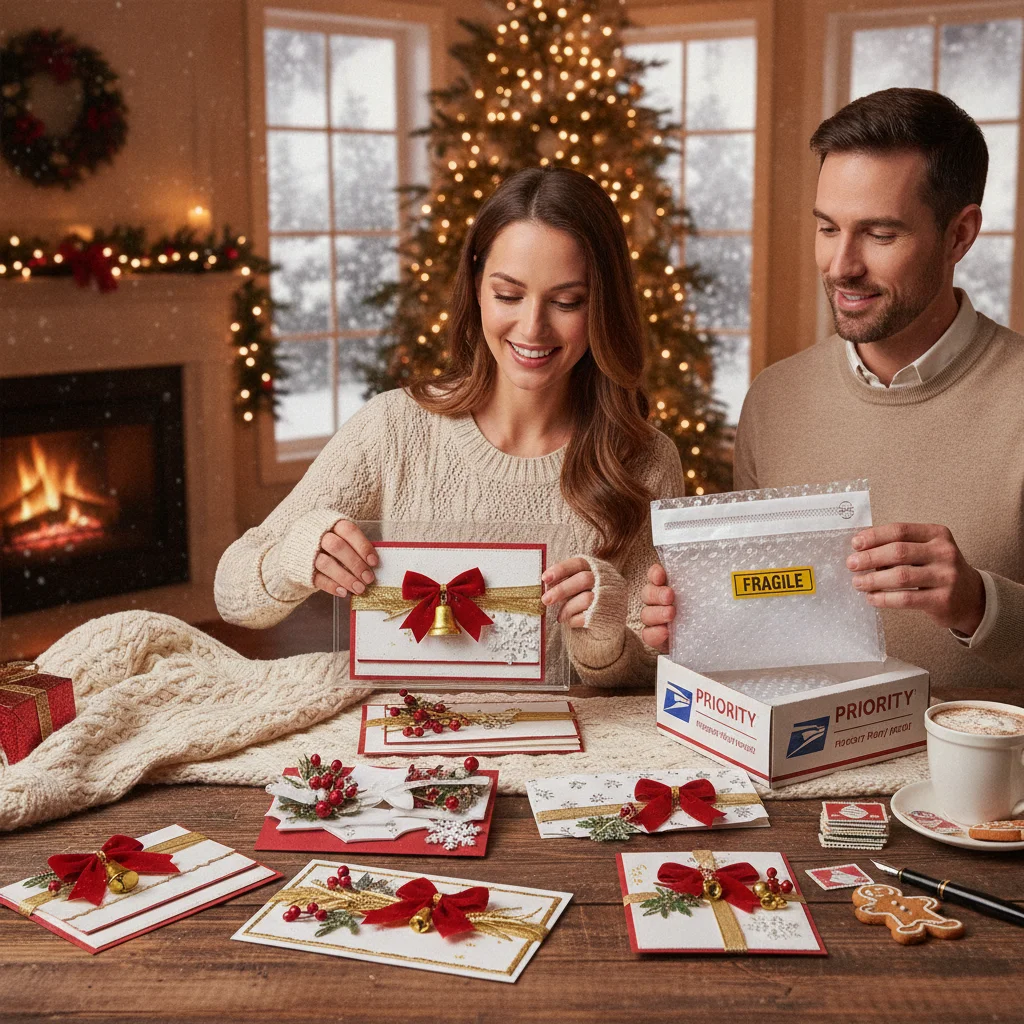
Quick answer: Protect embellished Christmas cards by covering raised details, placing each card in a sturdy envelope, and checking the finished piece for thickness, rigidity, and uneven surfaces. Cards with bulky ribbons, buttons, gems, or wax seals may need nonmachinable postage or package service. Ask the postal clerk to classify and weigh the finished envelope before mailing.
Handmade Christmas cards can survive the mail when their decorations are secured, cushioned, and packaged for the postal equipment they may encounter. The key is to evaluate the completed envelope rather than the undecorated card. A ribbon knot, button, gem, or wax seal can change the envelope's thickness, flexibility, and postage category.
Which Christmas card embellishments need extra protection?
Any decoration that creates a hard bump, catches on nearby material, or extends beyond the card needs protection. Common examples include rhinestones, beads, layered paper flowers, metal charms, wooden shapes, buttons, bows, twine, and thick adhesive foam.
Flat paper layers, stamped designs, and thin fabric ribbon are generally easier to mail. However, several layers concentrated in one area can still create an uneven envelope that is unsuitable for automated letter-processing equipment.
| Embellishment | Main mailing risk | Suggested protection |
|---|---|---|
| Ribbon or twine | Snagging or bulky knots | Flatten the bow and cover it with tissue or vellum |
| Gems or beads | Hard, uneven bumps | Add a smooth cardstock shield |
| Buttons or charms | Rigidity and envelope tears | Use padding or a small bubble mailer |
| Wax seals | Cracking or catching | Place the seal inside an outer envelope |
| Paper flowers | Crushing | Use a shallow box or rigid mailer |
How should you prepare the handmade card before packing it?
Let glue, paint, ink, and wax cure completely. Decorations that feel secure at first may shift if the adhesive is still soft. Gently test each embellishment by moving the card and brushing a finger around its edges.
Trim loose ribbon ends and avoid exposed wire, sharp metal, or protruding stems. Place a sheet of vellum, tissue, or plain paper over the decorated front so it does not rub against the envelope. For hard decorations, cut a piece of smooth cardstock slightly smaller than the envelope and position it over the embellishments as a protective shield.
A protective sleeve can help keep glitter or loose fibers contained, but it does not make a bulky card machinable. Avoid excessive layers because every insert increases the final thickness and weight.
What envelope should you use for an embellished Christmas card?
Choose an envelope that gives the card enough room without allowing it to slide around. For lightly layered designs, a heavy paper envelope may be sufficient. A small bubble mailer, rigid photo mailer, or shallow mailing box is safer for buttons, charms, large bows, dimensional flowers, or fragile wax seals.
Do not force a decorated card into a tight envelope. Pressure can bend the card, detach decorations, or make the envelope split during processing. If the envelope bulges noticeably, move to more protective packaging.
Square envelopes and unusually shaped pieces may require additional postage even when they are thin. A standard rectangular format is usually the simplest option for letter mailing.
How can you determine the correct postage?
Measure and weigh the card after adding every protective layer and sealing the envelope. Postal classification depends on the finished mailpiece, including its dimensions, weight, thickness, flexibility, and surface consistency.
In the United States, a letter that is square, rigid, or uneven may be subject to a nonmachinable surcharge. A very thick or inflexible envelope may be treated as a large envelope or package instead of a letter. Postage rates and classification rules can change, so a postal clerk should inspect unusual handmade cards.
Do not assume that adding an extra stamp automatically covers the correct service. The amount owed depends on how the carrier classifies the piece, not only on its weight.
What is the safest way to mail the finished card?
- Place protective paper over the decorated card front.
- Add a cardstock shield or padding where hard embellishments create pressure points.
- Insert the card without bending or compressing the decorations.
- Seal every envelope edge securely without placing tape over the address or postage area.
- Write or print the delivery and return addresses clearly.
- Take bulky, rigid, square, or uneven cards to a staffed postal counter for weighing and classification.
You can request hand cancellation where that service is available, but a request does not guarantee that the card will avoid all automated equipment later in transit. Correct packaging remains necessary.
For sentimental or time-intensive cards, protective packaging and counter acceptance are safer than trying to preserve letter-rate postage. If replacing the card would be difficult, use a tracked package service.
What limitations should senders consider?
No envelope can guarantee that a delicate embellishment will arrive unchanged. Mailpieces encounter stacking pressure, vibration, temperature changes, and repeated handling. Glitter, dried botanicals, brittle wax, and loosely attached items remain especially vulnerable.
Postal rules differ by country and service. International mail may also face customs restrictions for materials such as seeds, dried plants, food, or untreated wood. Confirm requirements with the destination carrier before mailing.
When an embellishment cannot be flattened or shielded safely, send the card in a small box. The higher postage cost can prevent damage to both the handmade card and other mail.
The postage detail that changes how you mail handmade Christmas cards with embellishments
The detail that changes how you mail a handmade Christmas card is whether the fully packed envelope remains flexible, evenly thick, and rectangular, because a rigid or lumpy piece may be treated differently from ordinary letter mail. Evaluate the sealed envelope, not the bare card: gently flex it, check whether a bow or gem creates a pronounced bump, and confirm that protective cardstock has not made the piece stiff throughout. There is no single postage amount determined by “embellished” status alone; the finished shape, dimensions, weight, and rigidity control classification. If the surface is uneven or the envelope cannot bend normally, take the completed piece to a postal counter for classification before adding postage. For concentrated decorations or bulky knots, use a small rigid mailer rather than forcing the card through letter-processing equipment.
Frequently asked questions
Can I mail a Christmas card with a ribbon bow?
A flat ribbon bow can usually be protected with tissue or vellum inside a sturdy envelope. A thick knot or large bow may require nonmachinable postage or package service.
Do handmade cards need extra postage?
Handmade cards may need extra postage when they are heavy, square, rigid, unusually thick, or uneven. A postal clerk can classify the completed envelope accurately.
Can I mail a card with rhinestones or gems?
Rhinestones and gems should be firmly attached and covered with a smooth cardstock shield. Large or concentrated gems are safer in a padded mailer.
Will the post office hand-cancel an embellished card?
Some postal locations offer hand cancellation upon request, but availability varies. Hand cancellation does not guarantee that the card will avoid automated handling throughout transit.
Can a wax-sealed Christmas card go through the mail?
An exposed wax seal may crack, snag, or make the envelope nonmachinable. Placing the sealed card inside a second outer envelope provides better protection.
Should I write nonmachinable on the envelope?
A nonmachinable marking does not replace the required postage or postal classification. Ask the carrier whether the marking is appropriate for the selected service.
When should I use a box instead of an envelope?
Use a box for fragile paper flowers, thick bows, charms, brittle wax, or decorations that cannot withstand pressure. Tracking is also sensible for valuable or irreplaceable handmade cards.
How do I keep embellishments from making an envelope uneven?
Place a smooth cardstock shield over raised decorations and fill nearby low areas with folded tissue so the sealed envelope has a gradual, even profile. Avoid loose padding that can shift toward one corner. After sealing, run your fingers across both sides; if one hard bump remains, use a rigid mailer and have the finished piece classified.
Can I put an embellished Christmas card inside a second envelope?
Yes, an inner envelope can prevent rubbing, but it does not remove postage or classification concerns created by thickness, rigidity, weight, or unevenness. Choose an outer envelope with enough room that the card slides in without pressure, then assess the fully sealed outer piece. If doubled envelopes make it stiff or bulky, use a mailer instead.