
What Wording Should You Use With an AI Christmas Photo?
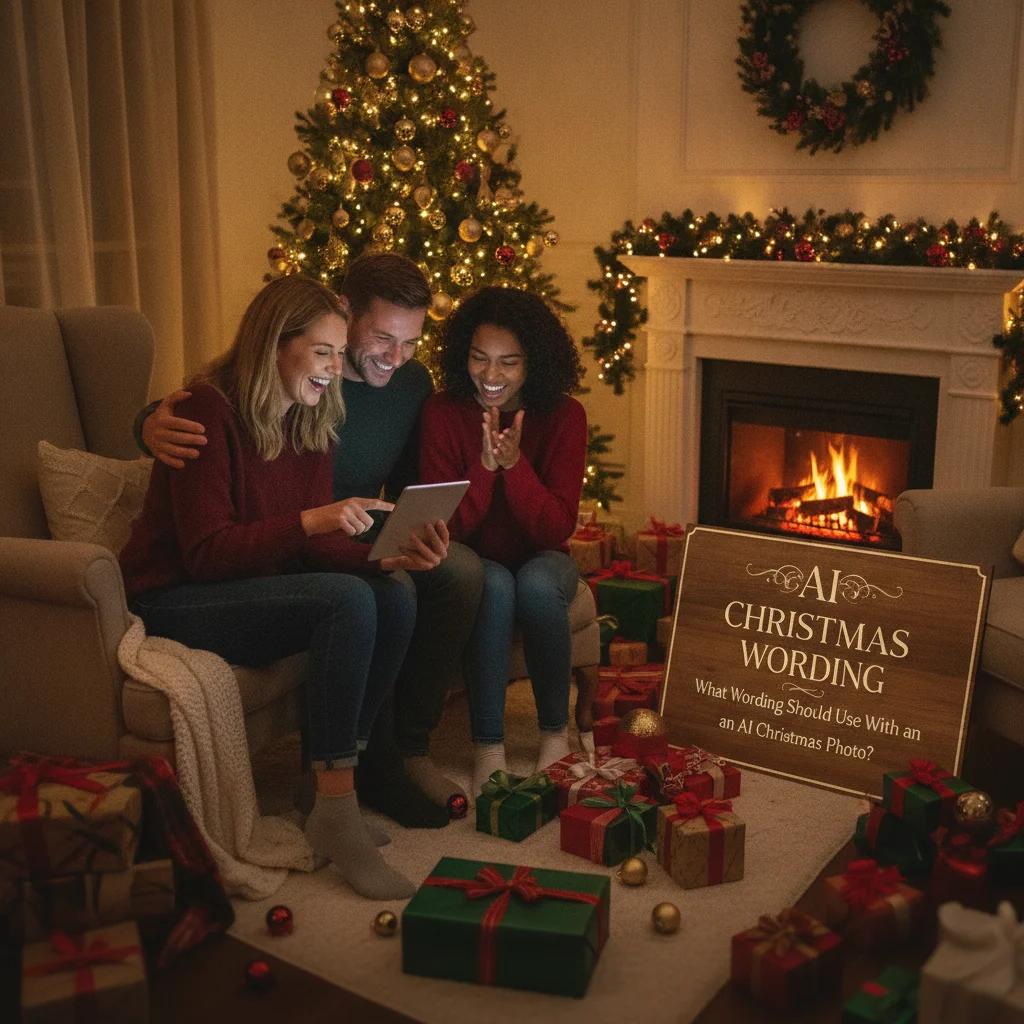
Quick answer: Use wording that matches how the AI Christmas photo will be shared. A printed card needs a warm greeting, while a social post may need a short caption and a clear AI disclosure. Keep the message personal, avoid implying that fictional details really happened, and label generated or heavily altered images when recipients could mistake them for authentic photographs.
AI Christmas photo wording can refer to the greeting printed beside an artificial intelligence image, the caption used when posting the image, or a disclosure explaining that the picture was generated or edited. The best wording usually combines a natural holiday message with enough context to prevent confusion.
A fictional snowy cabin, illustrated family portrait, or playful North Pole scene can still feel personal. The words should sound like the sender rather than describing every visual detail created by the software.
What should an AI Christmas photo message say?
A strong message has three simple parts: a seasonal greeting, a personal sentiment, and a sign-off. The image supplies the fantasy or visual joke, so the written message can remain direct.
For example: “Wishing you a peaceful Christmas filled with good food, warm company, and happy memories. With love, the Harris family.” This wording works whether the accompanying image is a traditional photograph, an AI illustration, or a heavily edited portrait.
If the image depicts something that did not happen, avoid language that presents the scene as a real event. A family shown at the North Pole could use “Our imagined trip to Santa’s workshop” rather than “Greetings from our North Pole vacation.”
Which wording style fits each type of Christmas photo?
| Photo style | Suggested wording |
|---|---|
| Elegant winter portrait | “Warmest wishes for a peaceful Christmas and a joyful season.” |
| Funny family scene | “Proof that Christmas magic can get a little out of hand.” |
| Fantasy North Pole image | “Sending a little imagined North Pole magic your way.” |
| Pet Christmas portrait | “Santa Paws sends treats, cheer, and very furry wishes.” |
| Religious card | “May the hope and peace of Christ be with you this Christmas.” |
| Business greeting | “Season’s greetings, with sincere thanks for your support.” |
The wording should also fit the relationship. Close relatives may appreciate an affectionate or humorous message. Clients, teachers, neighbors, and community contacts often need a shorter, more neutral greeting.
What are some short captions for AI Christmas photos?
- “Christmas magic, with a little digital help.”
- “Our holiday imagination brought to life.”
- “Not a real snow day, but the cheer is genuine.”
- “A merry moment made with AI.”
- “Artificial snow, real Christmas spirit.”
- “We asked for festive and got the full North Pole.”
- “A picture from the Christmas trip we took in our imagination.”
- “Generated scene, genuine wishes.”
Short captions are useful for social media because the image remains the focus. Printed cards can use a longer greeting inside, even when the front includes only a few words.
How should you disclose that a Christmas photo uses AI?
A disclosure is helpful when viewers could reasonably believe the picture records a real person, place, event, or achievement. Clear wording matters most for realistic family portraits, travel scenes, memorial images, public figures, and children.
Simple labels include “AI-generated image,” “Created with generative AI,” “AI-assisted holiday artwork,” and “Original photo edited with AI.” Use “AI-generated” when most or all of the scene was created artificially. Use “AI-edited” when a real photograph remains the main source but backgrounds, clothing, expressions, or objects were changed.
The disclosure does not need to dominate a personal card. A small line on the back can say, “Holiday artwork created with AI from our family photos.” A social caption can state the same information near the beginning or end.
How can you make the wording feel personal?
Mention one genuine detail from the year, such as a move, a new pet, a family tradition, or gratitude for the recipient. One specific detail usually feels more personal than several generic holiday phrases.
Match the family’s usual voice. A playful household might write, “We could not reach the North Pole, so technology handled the travel plans.” A more traditional sender might choose, “Although the scene is imagined, our wishes for your family are heartfelt.”
Names and sign-offs also create warmth. “With love,” “Merry Christmas from,” and “Warm wishes from our family to yours” are suitable for most personal cards.
What wording should you avoid?
Avoid claims that could mislead recipients about a real trip, reunion, engagement, pregnancy, award, or family event. AI images can look convincing enough to create genuine misunderstandings.
Avoid jokes about a person’s body, age, disability, religion, or financial situation. Do not imply that someone approved an altered portrait if that person has not seen it. For business messages, avoid overly familiar language and unverified claims about company milestones.
What are the limitations of AI Christmas photo wording?
Good wording cannot fix every issue in a generated image. AI tools may alter facial features, skin tone, body shape, cultural clothing, religious symbols, hands, text, or family resemblance. Review the final image closely before printing or posting it.
A disclosure also does not replace consent. Ask permission before generating or sharing realistic images of other adults or children, especially in public posts. Memorial pictures and images involving sensitive family circumstances require particular care.
Best approach: Pair a sincere Christmas greeting with a brief, accurate label when the image could be mistaken for a real photograph. The scene may be artificial, but the message should remain honest and personal.
When ready-made AI Christmas photo wording is enough—and when to write your own
Ready-made AI Christmas photo wording is enough when the image is the main attraction and the message only needs to convey a holiday wish, identify an imagined scene, or provide a brief AI disclosure. Use it for playful portraits, fantasy settings, and casual social posts where recipients do not need personal context.
Write one sentence of your own when the image includes a family tradition, recreates a meaningful place, refers to a difficult year, or could be mistaken for a real event. Name the detail that makes the picture relevant to your household, such as why you chose the setting or which family joke inspired it. There is no fixed test for how much personalization is necessary; the deciding question is whether the ready-made wording could accompany anyone else’s image without changing its meaning.
Why can funny AI Christmas photo wording sound copied while short wording feels personal?
Funny wording can sound copied when its joke does not match the people, setting, or degree of AI alteration shown in the Christmas photo. A surreal North Pole scene may support an exaggerated line about reindeer or impossible travel, while a lightly edited family portrait usually suits restrained humor tied to a familiar habit. By contrast, short wording depends less on a punchline and more on a recognizable voice. A simple greeting can feel personal when it uses the family’s usual sign-off, names the pictured place, or acknowledges the invented scene in natural language. Compare a broad joke such as “Powered by Christmas magic” with a specific line such as “Our annual snow day, with a little AI help.” Choose funny wording for a photo built around a visual gag; choose short wording when the image already tells the story.
Frequently asked questions
Should I say that my Christmas photo was made with AI?
A disclosure is recommended when the image looks realistic or shows an event that never happened. A simple label such as “AI-generated holiday image” is usually enough.
What is a funny caption for an AI Christmas picture?
“Artificial snow, real Christmas spirit” is a short option. “We let AI plan the family trip to the North Pole” works for a more playful scene.
Can I call an AI image a family photo?
You can describe it as an AI family portrait or AI-assisted family image. Calling a fully generated scene a photograph without context may mislead recipients.
Where should an AI disclosure appear on a Christmas card?
The disclosure can appear in small text on the back of a printed card or beneath the image online. ChristmasCard.io recommends keeping the label easy to find without making it the main greeting.
What should I write inside an AI Christmas card?
Use the same sincere message you would place inside any holiday card. Add one personal detail and a warm sign-off rather than focusing entirely on the technology.
Is “AI-edited” the same as “AI-generated”?
AI-edited usually means a real source photograph was altered, while AI-generated means most or all of the image was created artificially. Choose the term that accurately describes the process.
Can businesses use humorous AI Christmas photo wording?
Businesses can use light humor if it fits their established tone and audience. The message should remain professional, inclusive, and clear about realistic generated imagery.
Is a generic caption okay for an AI Christmas photo?
A generic caption is fine when the AI Christmas photo is decorative, humorous, or clearly fantastical. It can keep attention on the image without adding unnecessary explanation. Choose custom wording if the scene represents your family, suggests a real memory, or contains details that recipients may otherwise misunderstand.
How do I personalize ready-made AI Christmas photo wording?
Personalize it by replacing one broad phrase with a detail unique to the image or your household. Mention the imagined location, a recurring family joke, a pet’s role, or the reason you created the scene. Keep the original greeting if it works, then add one natural sentence that only your family could send.
Why does my AI Christmas photo caption sound generic?
It probably relies on a broad holiday phrase that could accompany almost any image. Replace one generic detail with something visible or personally familiar, such as the unusual setting, a family tradition, or your normal sign-off. Keep the reference brief so the wording complements the AI photo instead of explaining every generated element.