
Should a Christmas Card Return Address Be Printed or Handwritten?
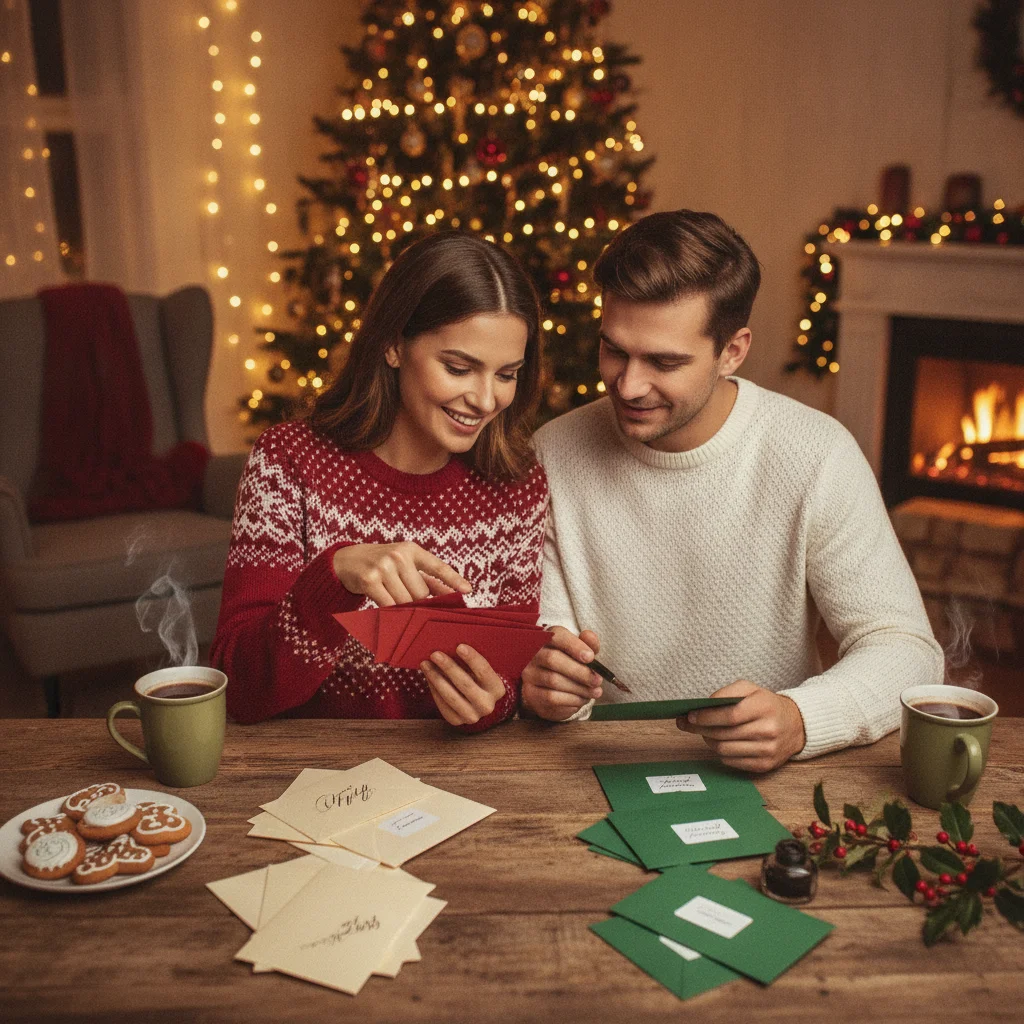
Quick answer: A Christmas card return address may be printed or handwritten. Handwriting feels personal and suits small or formal mailing lists, while printed labels, stamps, and envelope printing are practical for larger batches. Etiquette matters less than legibility, accurate formatting, and placing the return address in the upper-left corner or on the back flap.
A Christmas card return address can be handwritten, printed on a label, applied with a stamp, or printed directly on the envelope. All four methods are acceptable. The right choice depends on the formality of the card, the number of cards being mailed, and the amount of time available.
Traditional etiquette favors handwriting because it adds a personal touch. Modern etiquette also recognizes that printed return addresses are efficient, neat, and easy for postal equipment to read. A printed address does not make a Christmas greeting impersonal, especially when the card includes a handwritten note or signature.
What does Christmas card return address etiquette require?
The main purpose of a return address is practical. It allows the postal service to return an undeliverable card and tells the recipient where the sender currently lives. The address should therefore be complete, accurate, and legible.
Use the sender's name, street address, city, state abbreviation, and ZIP code. Apartment or unit numbers should appear on the street-address line when space permits. Avoid decorative lettering that makes numbers or abbreviations difficult to identify.
A return address is strongly recommended even though ordinary greeting cards do not always require one. It is especially useful during the holidays because recipients may have moved, changed names, or provided an outdated address.
Are printed labels or handwritten addresses more appropriate?
| Method | Best for | Etiquette impression |
|---|---|---|
| Handwritten | Small lists and formal cards | Personal and traditional |
| Printed label | Medium or large batches | Practical and acceptable |
| Address stamp | Annual card senders | Consistent and polished |
| Envelope printing | Coordinated stationery | Clean and professional |
A handwritten return address is a considerate choice for formal stationery, handmade cards, or a short recipient list. Use dark blue or black ink and write clearly rather than trying to imitate ornate calligraphy.
Printed return-address labels are appropriate when sending dozens of cards. Choose a simple typeface and a label color that coordinates with the envelope. Oversized graphics, reflective surfaces, and very small text can interfere with readability.
A self-inking stamp offers a middle ground. It saves time while retaining the appearance of intentionally prepared stationery. Direct envelope printing provides the most integrated look, particularly when the recipient address uses the same typeface.
Where should the return address appear on a Christmas card envelope?
The conventional placement is the upper-left corner on the front of the envelope. This location is familiar to postal workers and leaves the center available for the recipient's address.
The back flap is also widely used for social correspondence. A return address centered on the flap can create a cleaner front and is common on invitations and premium holiday stationery. Postal systems may process a front return address more reliably, however, especially if a card cannot be delivered.
Do not place the return address too close to the recipient's address. Postal scanners could interpret two similarly formatted address blocks incorrectly. Keep the recipient's information prominent and place postage in the upper-right corner.
Whose name should be listed in the return address?
A household may list individual first names, shared surnames, or a family name. Examples include “Jordan and Casey Lee,” “The Lee Family,” or simply the street address without a name. Including a name is helpful when recipients know more than one household at the same address.
Unmarried partners do not need to share a surname on the envelope. List both names on one line if space allows, or place each name on a separate line. Roommates sending separate cards should use their own names rather than a collective family description.
If the card comes from a business, club, or family organization, use the group's recognized name. The return address should identify the actual sender rather than the printing company or card designer.
Should the return address match the style of the recipient address?
Matching styles create a coordinated appearance, but etiquette does not require them to be identical. A handwritten recipient address can be paired with a printed return label. A printed recipient address can also be paired with an address stamp.
For a formal presentation, keep ink colors, typefaces, and alignment consistent. For casual family cards, clarity is more important than matching every detail. Avoid using red or pale metallic ink for essential address information because contrast may be poor.
How can you prepare return addresses correctly?
- Confirm the sender name and full mailing address.
- Choose handwriting, labels, a stamp, or direct envelope printing.
- Test the method on one spare envelope before completing the batch.
- Place the address in the upper-left corner or centered on the back flap.
- Check that the ink is dry and the text remains easy to read.
- Review every envelope for missing unit numbers or incorrect ZIP codes.
What are the limitations of printed and handwritten return addresses?
Handwriting takes time and can produce inconsistent results. Ink may smear on coated or glossy envelopes, and highly decorative scripts can reduce legibility.
Labels may peel at the edges, look less formal, or clash with textured stationery. Address stamps cannot be updated after a move, while direct printing requires compatible envelopes and careful printer setup. No method compensates for an incomplete or outdated address.
Verdict: Handwriting is the most personal option, but printed labels, stamps, and envelope printing are fully acceptable for Christmas cards. Choose the method that keeps every return address accurate, readable, and consistent with the card's tone.
How postage affects printed versus handwritten Christmas card return addresses
Postage does not change based on whether a Christmas card return address is printed or handwritten; legibility is the mailing detail that should determine your choice. Letter prices are based on factors such as weight, dimensions, thickness, and machinability rather than the writing method used for the return address (USPS, 2026). Use handwriting when you can form clear, evenly spaced characters that postal equipment and people can read. Choose a printed label, envelope printing, or a stamp when decorative handwriting, metallic ink, faint ink, or limited space could make the address unclear. Include the complete street address, city, state abbreviation, and ZIP Code. If the card is returned as undeliverable, a readable return address helps it come back to you; a more personal appearance does not outweigh reliable identification.
Who should check postage before printing a Christmas card return address?
A printed return address does not set postage; the finished Christmas card’s weight, envelope shape, thickness, and mailing date are the real traps. This guidance helps new parents sending photo cards, renters using a newly updated address, teachers mailing many cards, and professionals sending Christmas greetings to clients. Interfaith families can apply the same mailing check when Christmas cards are part of a broader holiday list. Assemble one complete envelope, including inserts and decorations, before purchasing postage or printing labels. Square envelopes, rigid contents, bulky seals, and extra enclosures may require different postage or handling, while mailing near a delivery deadline may leave fewer economical options. People hand-delivering cards, sending only digital greetings, or using envelopes already assessed with their exact contents can ignore this step.
Frequently asked questions
Is it rude to use printed return-address labels on Christmas cards?
Printed return-address labels are not rude. They are a practical and accepted choice, particularly for large mailing lists.
Can the return address go on the back of a Christmas card envelope?
The return address can be centered on the back flap. The upper-left front corner may be more reliable for postal processing.
Do Christmas cards need a return address?
A return address is generally recommended because it allows undeliverable cards to be returned. It also helps recipients confirm the sender's current address.
Should a return-address label include the family's name?
A family name is optional but useful for identification. The complete street address, city, state, and ZIP code are more important.
Is an address stamp acceptable for holiday cards?
An address stamp is acceptable and provides a consistent appearance. Use dark ink and confirm that every part of the impression is legible.
Should the return and recipient addresses use the same font?
Matching fonts can make an envelope look coordinated, but they are not required. Both address blocks should prioritize clarity.
Can red ink be used for a Christmas card return address?
Red ink can be used if it creates strong contrast against the envelope. Dark blue or black ink is usually easier for people and postal equipment to read.
Does a handwritten return address require extra postage?
No, handwriting the return address does not by itself require extra postage. Postage can increase because of the envelope’s weight, size, thickness, rigidity, or other nonmachinable features. A normally shaped Christmas card envelope with a readable handwritten return address is assessed under the same postage rules as one with a printed return address.
What should I do if my handwritten return address is difficult to read?
Use a printed return address if your handwriting may be difficult to read. A label, address stamp, or direct envelope printing is more practical than decorative script when characters could be mistaken for one another. Check that the ZIP Code is clear and that ink does not smear against a coated or glossy envelope.
Does a printed return-address label change Christmas card postage?
A normal paper return-address label usually does not change postage by itself. Postage depends on the completed envelope’s weight, dimensions, thickness, flexibility, and other mailing characteristics. Test one fully assembled Christmas card rather than weighing an empty envelope, especially when adding photographs, newsletters, ribbons, seals, or multiple inserts.