
Beautiful Bilingual Spanish-English Christmas Card Ideas
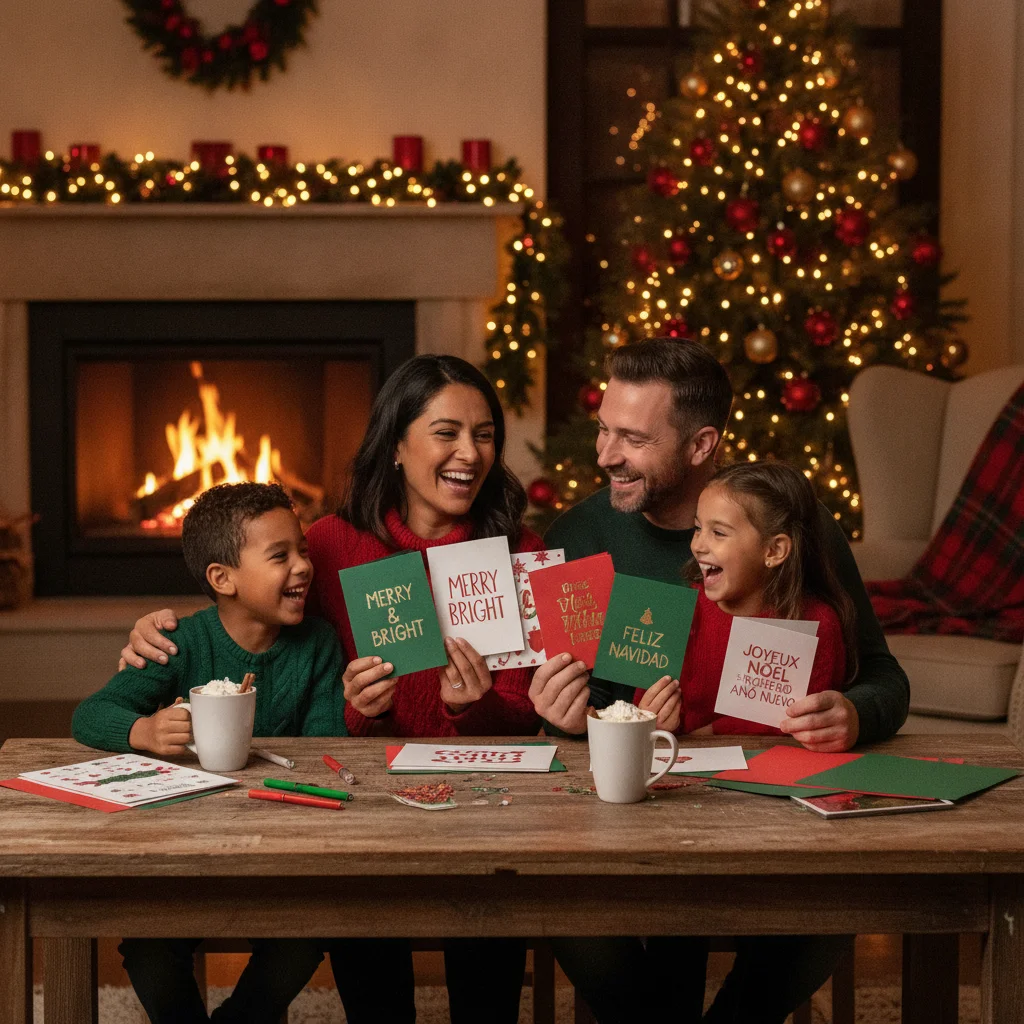
Quick answer: A thoughtful bilingual Christmas card pairs a natural English greeting with an equally warm Spanish message rather than translating every word literally. Choose wording that fits the recipient, such as “Merry Christmas / Feliz Navidad,” “Happy Holidays / Felices Fiestas,” or a longer message about family, peace, faith, and the New Year.
Bilingual Spanish-English Christmas cards can honor two languages while making every recipient feel included. The best designs treat both languages with equal care, using natural expressions, readable typography, and a message suited to the relationship.
A short greeting works well for photo cards and large mailing lists. Longer wording gives family cards, religious cards, and personal notes more emotional depth.
What are some simple bilingual Christmas card greetings?
Simple greetings are easy to arrange on a card and familiar to speakers of both languages. These options work for relatives, neighbors, classmates, and community groups.
- Merry Christmas! ¡Feliz Navidad!
- Happy Holidays! ¡Felices Fiestas!
- Season’s Greetings. Saludos de la temporada.
- Peace and joy. Paz y alegría.
- With love this Christmas. Con cariño esta Navidad.
- Best wishes for the holidays. Nuestros mejores deseos para estas fiestas.
“Feliz Navidad” specifically refers to Christmas. “Felices Fiestas” is broader and can include Christmas, New Year’s Day, and the general holiday season.
Which bilingual messages work well for family cards?
Family cards often sound warmer when the two versions express the same idea without following identical sentence structures. A natural pair could read: “Wishing your family a Christmas filled with love and laughter. Que su familia disfrute una Navidad llena de amor y alegría.”
For a card sent by an entire household, try: “With love from our family to yours. Con cariño, de nuestra familia para la suya.” A more casual version is: “Sending Christmas hugs from all of us. Les mandamos abrazos navideños de parte de toda la familia.”
Families celebrating across different countries can acknowledge the distance: “Though miles apart, we are together in spirit this Christmas. Aunque estemos lejos, esta Navidad estamos unidos de corazón.”
How can a card combine Christmas and New Year wishes?
Combining both occasions keeps the card relevant after December 25. It is also a natural choice when sending greetings to professional contacts or a culturally diverse group.
| Style | English and Spanish wording |
|---|---|
| Classic | Merry Christmas and Happy New Year. Feliz Navidad y Próspero Año Nuevo. |
| Warm | May the coming year bring you health and happiness. Que el año nuevo les traiga salud y felicidad. |
| Casual | Cheers to a joyful holiday and a wonderful New Year. Brindemos por unas fiestas alegres y un maravilloso Año Nuevo. |
| Professional | Best wishes for the holiday season and the year ahead. Nuestros mejores deseos para estas fiestas y el próximo año. |
Capitalize “Navidad” and “Año Nuevo” when they name the holidays. Spanish punctuation also requires an opening exclamation mark in exclamatory greetings, as in “¡Feliz Navidad!”
What can a faith-based bilingual Christmas card say?
A religious greeting can focus on the birth of Jesus, God’s blessings, or the peace of Christmas. One traditional option is: “May the joy of Christ’s birth fill your home. Que la alegría del nacimiento de Cristo llene su hogar.”
Another message is: “God bless you and your family this Christmas. Que Dios los bendiga a usted y a su familia esta Navidad.” For close friends or relatives addressed informally, use “Que Dios te bendiga a ti y a tu familia esta Navidad.”
A Bible verse may also be printed in both languages, but confirm the wording in the specific English and Spanish Bible translations being quoted. Translations can differ in phrasing and capitalization.
How should both languages be arranged on the card?
Give English and Spanish comparable font sizes and visual prominence. Placing one language directly beneath the other makes the relationship clear, while a side-by-side layout can suit a landscape card.
A divided front can feature “Merry Christmas” on one side and “Feliz Navidad” on the other. Inside, a shared bilingual message can bring the design together.
Avoid assigning one language to tiny secondary text. Equal presentation communicates that both audiences are valued. Decorative accents inspired by family traditions can add personality, but they should not make either language difficult to read.
How can the wording feel personal rather than translated?
Start with the meaning, not a word-for-word conversion. English phrases such as “warmest thoughts” or “the magic of the season” may sound stiff when translated literally. A fluent Spanish expression can carry the same warmth with different words.
Add names, a family memory, or a specific hope for the recipient. For example: “We hope to share tamales and stories with you again soon. Esperamos volver a compartir tamales y recuerdos con ustedes muy pronto.”
Choose the correct form of address. “Tú” is informal singular, “usted” is formal singular, and “ustedes” addresses multiple people across most Spanish-speaking regions. Regional usage varies, so follow the language your recipients normally use.
What limitations should card writers consider?
Spanish varies by country, region, and family. A phrase that sounds natural in Mexico may be less common in Spain, Puerto Rico, Argentina, or another Spanish-speaking community.
Automatic translation can miss tone, formality, idioms, and agreement between singular and plural forms. Ask a fluent speaker familiar with the recipient’s dialect to review longer or sensitive messages.
Not every recipient celebrates Christmas religiously. Use “Happy Holidays / Felices Fiestas” when a broader seasonal greeting is more appropriate, and reserve explicitly Christian messages for recipients whose beliefs are known.
Best approach: Choose a concise message, write naturally in both languages, and give English and Spanish equal space. A personal closing such as “With love / Con cariño” can make even a simple greeting feel sincere.
When Bilingual Spanish-English Christmas Card Ideas Feel Considered Rather Than Generic
Bilingual Spanish-English Christmas card ideas feel considered when both languages reflect the recipients’ relationships, cultural habits, and natural ways of speaking. Choose wording your family or community would actually use rather than pairing two formal dictionary equivalents. A shared memory, family nickname, regional expression, or familiar term of affection can make the message specific without making it long.
Keep the emotional meaning consistent, but do not force every sentence into a line-by-line translation. One language might carry the main greeting while the other adds a personal thought, provided readers are not excluded from essential information. Code-switching can work when it resembles how the sender and recipient normally communicate. Check accents, punctuation, gender, and number with a fluent speaker when possible. There is no universal formula for balancing the languages because preferences vary among families and Spanish-speaking communities.
Frequently asked questions
What is the most common bilingual Christmas greeting?
“Merry Christmas! ¡Feliz Navidad!” is the most recognizable English-Spanish Christmas greeting. It is concise and suitable for most personal cards.
Is “Felices Fiestas” the same as “Feliz Navidad”?
“Felices Fiestas” means “Happy Holidays,” while “Feliz Navidad” specifically means “Merry Christmas.” The broader phrase can also cover New Year celebrations.
How do you say Merry Christmas and Happy New Year in Spanish?
The standard wording is “¡Feliz Navidad y Próspero Año Nuevo!” A less formal alternative is “¡Feliz Navidad y Feliz Año Nuevo!”
Should English or Spanish appear first on a bilingual card?
Either language can appear first, depending on the recipients and design. Giving both versions equal size and prominence is more important than their order.
Can a bilingual Christmas card use different wording in each language?
Yes, each version can use natural phrasing rather than a literal translation. Both messages should retain the same basic meaning and emotional tone.
What is a good bilingual Christmas card closing?
Useful closings include “With love / Con cariño,” “Warm wishes / Con nuestros mejores deseos,” and “From our family to yours / De nuestra familia para la suya.”
Should Spanish Christmas greetings include accent marks and opening punctuation?
Yes, correct Spanish uses accents and opening punctuation, such as “¡Feliz Navidad y Próspero Año Nuevo!” Proper spelling makes the card look polished and respectful.
Can I mix Spanish and English in the same sentence on a Christmas card?
Yes, you can mix Spanish and English when that reflects how you and the recipient normally speak. Keep the sentence easy to understand and avoid switching languages merely for decoration. Natural code-switching often uses a familiar greeting, affectionate phrase, family saying, or closing in one language within a message written mainly in the other.
How can I address a bilingual Christmas card to grandparents?
Use the names or family titles your grandparents recognize and prefer, such as Abuela, Abuelo, Grandma, Grandpa, or a personal nickname. The greeting can include both languages, while the body may follow your family’s usual speech pattern. Add a specific expression of gratitude, memory, or holiday wish to make the card feel personal.