
How to Light Christmas Studio Portraits
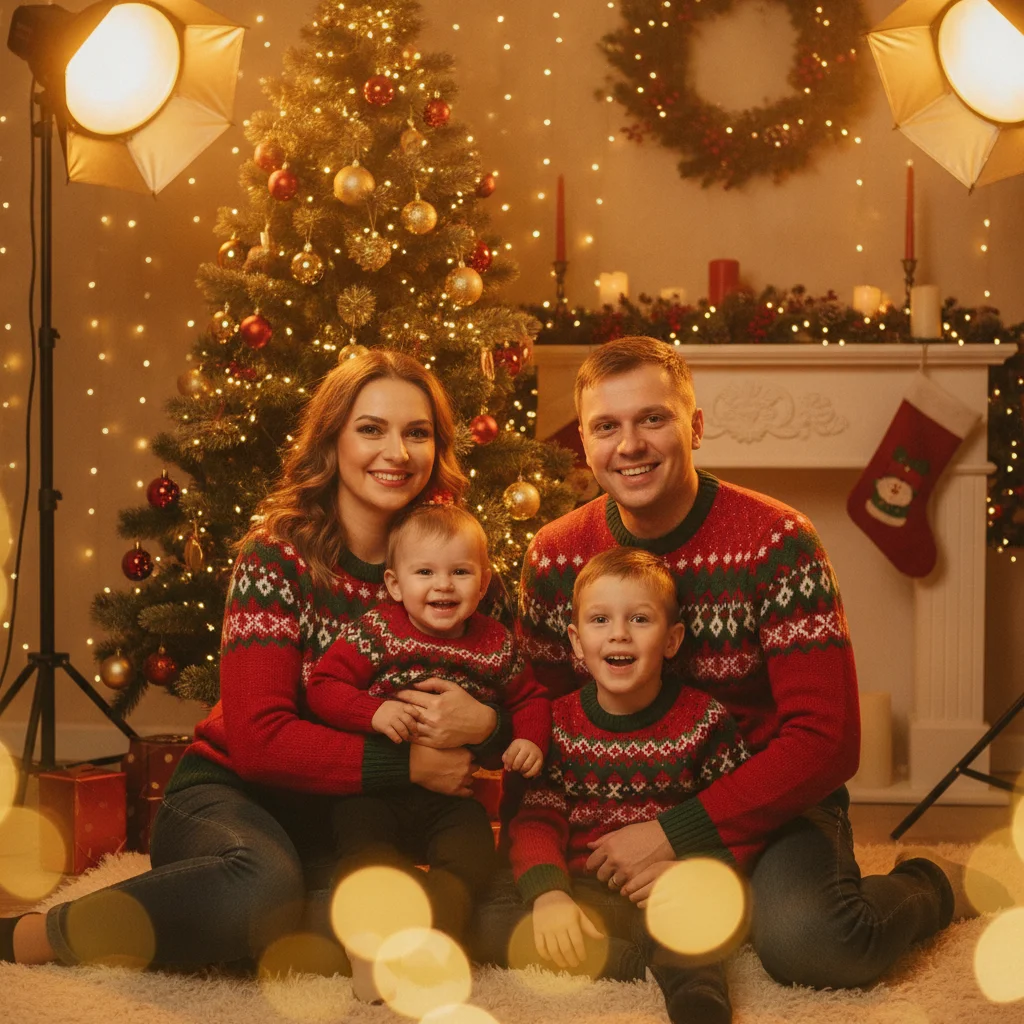
Quick answer: Light Christmas studio portraits with a large, soft key light placed about 45 degrees from the subjects, then add gentle fill or a reflector to control shadows. Keep people several feet from the background, expose for faces rather than Christmas lights, and use a wide aperture or greater subject-to-background distance to turn decorative bulbs into soft bokeh.
Christmas studio portraits need flattering light on faces while preserving the warm glow of trees, string lights, ornaments, and candles. The main challenge is balancing studio flash or continuous lighting with decorative lights that are much dimmer. A controlled setup, moderate ambient exposure, and careful subject placement produce a festive result without muddy skin tones or blown highlights.
What is the best basic lighting setup for Christmas portraits?
Start with one large softbox or umbrella as the key light. Position it about 45 degrees to one side of the camera and slightly above eye level, angled down toward the subjects. Place the modifier close enough to create soft shadows but outside the frame.
Add a white reflector on the opposite side to brighten deep facial shadows. If the portrait includes a large family, move the key light farther away and use a larger modifier so illumination remains even across the group.
A second light is optional. It can provide restrained fill near the camera axis or act as a hair light aimed from behind. Keep its output lower than the key light so the portrait retains shape and does not look flat.
How should the camera and lights be balanced?
Set the decorative Christmas lights first, then add light to the subjects. Begin around ISO 400 to 800, 1/100 to 1/200 second, and f/2.8 to f/5.6. Take a test frame without flash and adjust until the bulbs appear warm and visible but the room remains underexposed.
Turn on the key light and raise or lower its power until faces are correctly exposed. Shutter speed mainly affects continuous ambient light, while aperture and ISO affect both ambient light and flash. Stay at or below the camera's normal flash synchronization speed unless the equipment supports high-speed sync.
| Portrait type | Starting aperture | Suggested approach |
|---|---|---|
| Single person | f/2.8 to f/4 | Large key light with reflector fill |
| Couple | f/4 to f/5.6 | Keep both faces on a similar focal plane |
| Family group | f/5.6 to f/8 | Use a large modifier farther from the group |
| Child near a tree | f/2.8 to f/4 | Use low-power flash and preserve bulb glow |
How can Christmas lights become soft background bokeh?
Place the subjects well in front of the tree or string lights. A separation of six to ten feet often works well in a studio, although smaller sets can still produce blur with a longer focal length and wide aperture.
Use a lens between roughly 50mm and 135mm, open the aperture, and focus precisely on the nearest eye. The combination of subject separation, focal length, and aperture makes individual bulbs appear as soft circles. Avoid placing bright bulbs directly behind a person's face because they can create distracting halos.
How do you keep skin tones natural around holiday decorations?
Christmas sets often mix warm tungsten bulbs, cool LEDs, window light, and flash. Use one dominant color source on the subjects. A daylight-balanced key light gives consistent skin, while warm background lights retain their golden appearance.
Set a manual white balance or photograph a gray card under the key light. If the background appears too orange, reduce its warmth during editing rather than cooling the entire photograph. Cooling the full image can make skin look pale or blue.
Where should families and children stand?
Keep subjects away from the backdrop to reduce hard shadows and improve background blur. Arrange family members with faces close together and at similar distances from the key light. Turn bodies slightly toward the light rather than lining everyone up squarely.
For young children, lower the key light while keeping it above eye level. Mark a safe sitting or standing position on the floor. Secure light stands with sandbags, cover cables, and keep hot bulbs, glass ornaments, and unstable props out of reach.
How can glare on ornaments and glasses be controlled?
Large ornaments, metallic wrapping paper, and eyeglasses reflect the apparent shape of the light source. Raise the key light, move it farther to the side, or change the subject's head angle until the reflection leaves the camera's viewing angle.
Do not remove all ornament reflections because highlights help glossy decorations look dimensional. Aim to prevent clipped white patches and reflections that obscure eyes. A circular polarizer offers limited help with metallic objects and can cost valuable light.
What lighting mistakes should be avoided?
- Using direct on-camera flash, which creates flat faces and harsh background shadows.
- Lighting the set so brightly that decorative bulbs disappear.
- Placing subjects too close to the tree or printed backdrop.
- Using a very wide aperture when several faces occupy different focal planes.
- Mixing several light colors on skin without a clear correction plan.
- Allowing the key light to spill onto the background and reduce contrast.
What limitations should photographers expect?
A small studio may not provide enough distance for strong bokeh or full-length group portraits. Wider lenses can fit more people, but they may stretch faces near the frame edges. Bounce flash may also introduce unwanted color from red, green, or wood-paneled surfaces.
Decorative LED lights can flicker or change brightness at certain shutter speeds. Test several frames and inspect them at high magnification. When children move quickly, preserving sharp faces may require a faster shutter speed, higher ISO, or more flash contribution, even if the background glow becomes less prominent.
A reliable Christmas portrait starts with soft directional light on the people and controlled underexposure in the decorated background. Build the exposure around the Christmas bulbs, add only enough key light for clean skin tones, and maintain sufficient depth of field for every face.
Which Settings Make Christmas Studio Portraits Ready for Printing?
To make Christmas studio portraits print-ready, start at ISO 100, f/8, and a shutter speed within the camera’s flash-sync limit, then adjust flash power for clean, unclipped skin tones. ISO 100 limits visible noise, while f/8 usually gives a posed family enough depth of field when faces are arranged on nearby planes. Check the histogram and highlight warning after adding reflective ornaments, sequins, or white clothing; lower flash power if those areas clip. Capture RAW files so white balance and highlight recovery remain flexible, and focus on the eye nearest the camera. For a 5-by-7-inch card at 300 DPI, export a final image at 1500 by 2100 pixels (Vistaprint, 2026). Apply output sharpening only after the portrait is cropped to the card layout.
After-dark Christmas studio sessions are not always necessary
Shooting Christmas studio portraits after dark is unnecessary when daylight can be fully blocked or the session’s needs outweigh the benefit of stable ambient light. Noon sessions often cause shifting brightness and mixed color through uncovered windows, while darkness lets the photographer control every visible light source. However, a windowless studio or effective blackout curtains remove that difference. Daytime may also be preferable for pets that become anxious or tired in the evening, children with early routines, or workplace groups available only during business hours. For a family observing an evening religious tradition or coping with grief, insisting on a nighttime appointment can add avoidable strain. Keep the noon booking, block window spill, turn off conflicting overhead fixtures, and build the portrait with controlled studio lights instead.
Frequently asked questions
What color temperature is best for Christmas portraits?
A daylight-balanced key light around 5000K to 5600K gives consistent skin tones. Warm decorative lights can remain warmer in the background for contrast.
Can one light be used for Christmas studio portraits?
One large soft key light and a white reflector can produce polished individual, couple, and small-family portraits. Position the reflector opposite the key light to control shadow depth.
Should Christmas tree lights be on during the portrait?
Christmas tree lights should usually remain on because they add depth and warm highlights. Expose them below clipping, then add studio light to the subjects.
What lens works best for Christmas studio portraits?
A 50mm to 85mm lens is practical for most indoor portraits, while longer lenses can create stronger background blur when space allows. Wider lenses are useful for groups but require careful edge placement.
Is flash or continuous light better for Christmas portraits?
Flash is effective for freezing children and producing clean images at lower ISO settings. Continuous light makes the balance with decorative bulbs easier to preview but may require higher ISO or slower shutter speeds.
How far should subjects stand from a Christmas backdrop?
Three to six feet is a useful minimum for reducing backdrop shadows, while greater separation produces stronger blur. The exact distance depends on studio size, lens choice, and composition.
How do photographers avoid blurry Christmas portraits?
Use a shutter speed suitable for the subject's movement, focus on the nearest eye, and choose enough depth of field for the group. Flash can help freeze motion when children or pets will not stay still.
What ISO should I use for Christmas studio portraits?
ISO 100 is the best starting point when studio flash provides enough light. It preserves color, minimizes noise in shadowed clothing, and leaves more editing latitude than a high ISO. Raise it only when flash power, recycle time, or decorative ambient lights require a brighter exposure, and recheck highlight clipping after every change.
Why do Christmas studio portraits look darker in print?
They often look darker because a bright monitor and deep shadow editing can hide how much tonal detail the print will lose. Reduce monitor brightness, inspect the histogram, and make a small proof at the final size. Lift midtones selectively rather than increasing the entire exposure, which can wash out skin and glowing decorations.
Is noon a bad time for Christmas studio portraits?
Noon is only problematic when strong window light enters the studio and competes with the portrait lighting. Direct or changing daylight can alter exposure, shadow direction, and color during the session. Blackout curtains, flags, or a windowless room allow consistent results at midday.