
How Do You Take Christmas Portraits With Beautiful Lights and Bokeh?
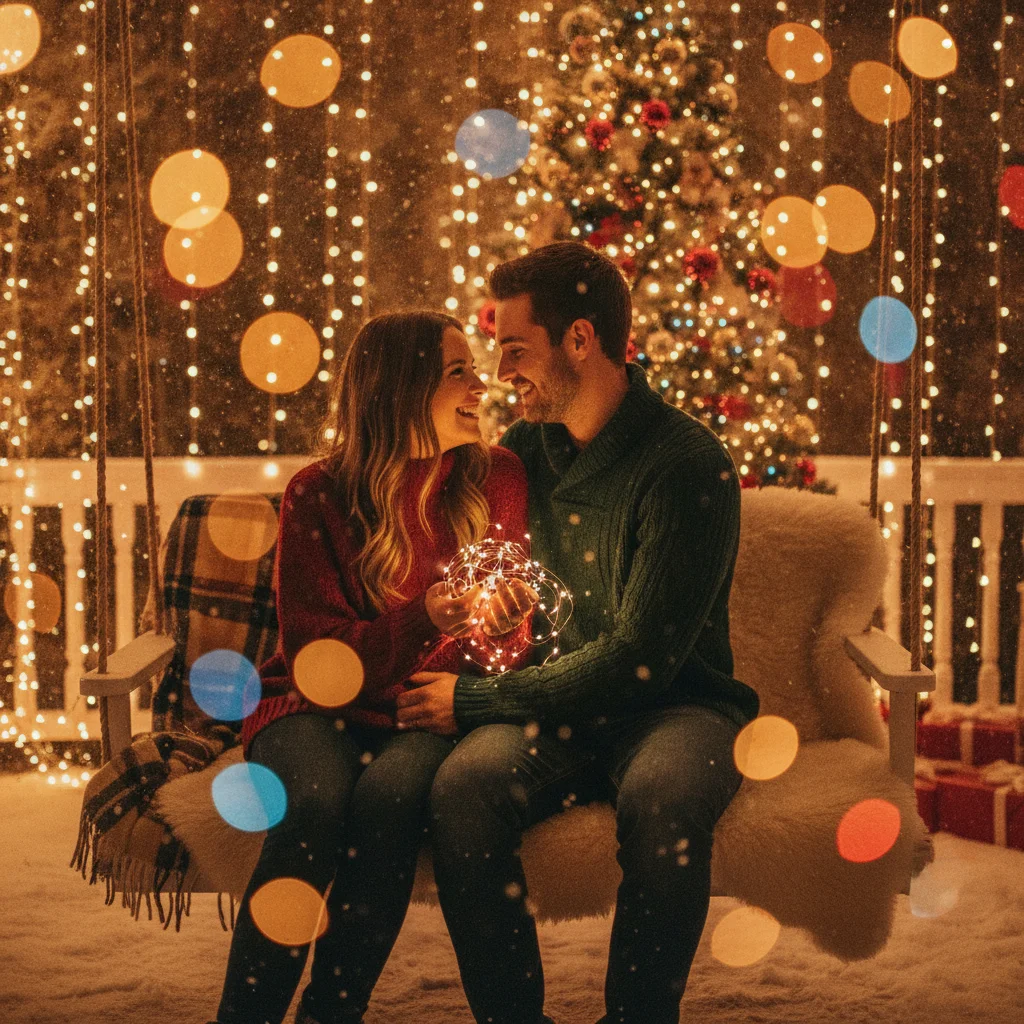
Quick answer: Place the subject several feet in front of the Christmas lights, use a wide aperture such as f/1.8 to f/2.8, and focus precisely on the nearest eye. A longer focal length and greater distance between the subject and lights will make the light points appear larger and softer. Expose for the face while protecting bright bulbs from clipping.
Christmas lights can turn an ordinary portrait background into soft circles of color. The effect depends less on the number of lights than on the spacing between the camera, subject, and background. Good focus, controlled exposure, and flattering light on the face are just as important as a wide aperture.
Photographers often use the word bokeh for both background blur and the appearance of individual out-of-focus highlights. In a Christmas portrait, the goal is usually a sharp face surrounded by smooth, recognizable light circles rather than a generally blurry image.
How should you position the subject and Christmas lights?
Place the subject well in front of the Christmas tree, light curtain, or decorated wall. Start with about 6 to 10 feet between the subject and the lights when space allows. Increasing this distance makes the bulbs look softer and larger.
Keep the camera reasonably close to the subject. A waist-up or head-and-shoulders composition usually produces stronger bokeh than a full-body portrait because the tighter framing reduces visible background detail.
Avoid placing a bright bulb directly behind an eye, nose, or edge of the face. Shift the camera slightly until the light circles fill empty areas around the subject without creating distracting visual overlaps.
Which camera settings create soft Christmas light bokeh?
Use aperture priority or manual exposure and select a wide aperture. Lenses often produce stronger background blur at f/1.4 to f/2.8, but stopping down slightly can improve eye sharpness when photographing two or more people.
| Situation | Suggested starting point | Reason |
|---|---|---|
| One person, still pose | f/1.8, 1/160 second, Auto ISO | Strong blur with enough shutter speed for small movements |
| Couple or small group | f/2.8 to f/4, 1/200 second | More depth of field for multiple faces |
| Active child or pet | f/2 to f/2.8, 1/320 second or faster | Reduces motion blur |
| Phone portrait mode | 1x to 3x camera, subject away from lights | Improves perspective and simulated background separation |
Check the result rather than treating these values as fixed rules. Raise ISO when the face is too dark instead of choosing a shutter speed that cannot freeze movement. Modern cameras generally produce a better portrait with moderate noise than with motion blur.
Which lenses make Christmas lights look best?
A 50mm, 85mm, or similar portrait lens is a practical choice. Longer focal lengths provide a narrower field of view and can make background lights appear more prominent behind the subject. A fast lens also allows a wider aperture than most basic zoom lenses.
A kit lens can still work. Use its longest focal length, open the aperture as far as the lens permits, move the subject away from the background, and step back to frame the portrait. Physical distance often matters more than owning an expensive lens.
How should you light and expose the face?
Christmas bulbs rarely provide enough flattering light by themselves. Place the subject near a window, soft lamp, diffused flash, or small LED panel. Aim for soft light from slightly above eye level and about 30 to 45 degrees from the face.
Expose primarily for skin while checking that the brightest bulbs retain some color. If the lights turn into blank white spots, reduce exposure or lower their brightness. RAW capture provides more room to recover highlights and adjust shadows during editing.
Mixed lighting can create orange skin, blue shadows, or inconsistent colors. Set a fixed white balance when possible, then fine-tune it later. A starting range around 3200K to 4000K often suits warm indoor decorations, although the correct value depends on the room lights.
How do you keep the eyes sharp at wide apertures?
Choose single-point autofocus, eye detection, or a small focus area and place it on the eye nearest the camera. Take short bursts because a slight sway by either the photographer or subject can move the eye outside the narrow focus plane.
Keep both eyes close to the same distance from the camera. If the face is turned sharply, stop down from f/1.4 to f/2 or f/2.8. For groups, arrange faces on a similar plane and use f/4 or narrower when needed.
How can phones create a convincing bokeh portrait?
Use portrait mode in good light and leave clear space around hair, hats, and shoulders. Computational blur may struggle with tinsel, glasses, curls, and overlapping decorations, so inspect the edges before ending the session.
A phone with a 2x or 3x camera often gives a more flattering portrait perspective than an ultra-wide camera. Avoid digital zoom in dim rooms. If portrait mode produces obvious cutout errors, use the standard camera and create natural separation through distance instead.
What posing and composition choices improve the portrait?
- Ask the subject to turn the body slightly while keeping the face toward the main light.
- Place light circles around the head rather than directly across facial features.
- Include a foreground decoration near the lens for an extra layer of soft color.
- Photograph both horizontal and vertical versions for cards, prints, and social crops.
- Use a calm expression or a simple activity, such as holding an ornament, to keep hands natural.
What limitations should you expect with Christmas light bokeh?
Very wide apertures reduce the margin for focusing errors. Large families, moving children, and pets usually need a smaller aperture or faster shutter speed than a quiet solo portrait.
Some LED strings flicker and can create dark bands or uneven brightness, especially with electronic shutters. Try a mechanical shutter, change the shutter speed, or enable an anti-flicker setting if the camera provides one.
Decorative lights can become hot, create trip hazards, or overload electrical outlets. Use undamaged indoor-rated lights, secure cables, and keep bulbs away from fabrics, children, and pets.
The most reliable formula is a tightly framed subject, generous distance from the background, a moderately wide aperture, sharp focus on the nearest eye, and a separate soft light for the face. Adjust those elements before adding more decorations or editing effects.
Christmas light bokeh is easier after dark than at noon
A common belief is that a wide aperture alone will produce vivid Christmas light bokeh at noon, but strong ambient light often makes the bulbs appear faint or disappear. Background blur may still form, yet the scene’s daylight exposure leaves little contrast between the glowing bulbs and their surroundings. After dark, the background becomes naturally dimmer, so the lights can register as colorful circles without requiring them to overpower sunlight. Keep the subject several feet in front of the lights, expose to preserve the bulbs’ color, and illuminate the face separately with a soft lamp, flash, or nearby window at dusk. If noon is the only option, move indoors, close curtains, avoid bright windows in the frame, and reduce ambient light before adjusting the aperture.
What makes a Christmas lights bokeh portrait ready to print?
For print-ready Christmas lights bokeh portraits, expose the face with a soft, diffused key light while adjusting the camera until the brightest bulbs retain color and texture. Use manual exposure, RAW capture, and the lowest ISO that still allows a safe shutter speed; for a stationary person, begin around 1/125 second and raise it for children or movement. Check the highlight warning and histogram rather than trusting the screen, because clipped bulbs become blank white spots in print. Keep the face bright enough to avoid lifting deep shadows later, which can reveal noise and muddy skin tones. Export in the card’s aspect ratio without enlarging a small file. A 5-by-7 print at 300 DPI requires 1500 × 2100 pixels (Vistaprint, 2026).
Frequently asked questions
What aperture is best for Christmas light bokeh portraits?
An aperture between f/1.8 and f/2.8 is a strong starting point for one person. Groups often need f/4 or narrower to keep every face sharp.
How far should the subject stand from the Christmas tree?
A separation of about 6 to 10 feet often creates soft, distinct light circles. More distance generally produces stronger background blur.
Can a kit lens create Christmas light bokeh?
A kit lens can create bokeh when used at its longest focal length and widest available aperture. Moving the subject farther from the lights improves the effect.
Why do Christmas lights look white instead of colorful?
The bulbs are probably overexposed. Reducing exposure or lowering the light-string brightness can preserve their individual colors.
Why are the eyes blurry in wide-aperture portraits?
A wide aperture creates a shallow focus plane that makes small movements noticeable. Eye autofocus, a faster shutter speed, and a slightly narrower aperture improve consistency.
Can portrait mode on a phone create Christmas bokeh?
Portrait mode can simulate bokeh when the subject has clear edges and stands away from the lights. Hair, tinsel, glasses, and overlapping objects can cause artificial-looking blur errors.
Should Christmas lights be the main light on the face?
Decorative bulbs usually work better as background accents than as the main facial light. A window, diffused flash, lamp, or LED panel provides more even illumination.
Can you take Christmas light bokeh portraits during the day?
Yes, but the room or background must be darker than normal daylight conditions. Move away from uncovered windows, close curtains, and place the lights in a shaded area. A wide aperture can blur the bulbs, but reducing ambient light is what helps their color and glow remain visible.
Is dusk or nighttime better for Christmas light portraits?
Dusk is often easier because it provides some natural light for the face while allowing the Christmas lights to stand out. Nighttime creates stronger contrast but usually requires a separate soft light on the subject. In either case, expose carefully so the bulbs retain color instead of becoming plain white spots.
Should I use flash for Christmas light bokeh portraits?
Use flash only as a controlled fill or key light, not as a direct blast toward the subject. Bounce it from a neutral wall or ceiling, or soften it through diffusion. Set the ambient exposure first so the Christmas lights remain visible, then add enough flash to brighten the face without creating hard shadows.