
How to Pose a Family for Christmas Photos
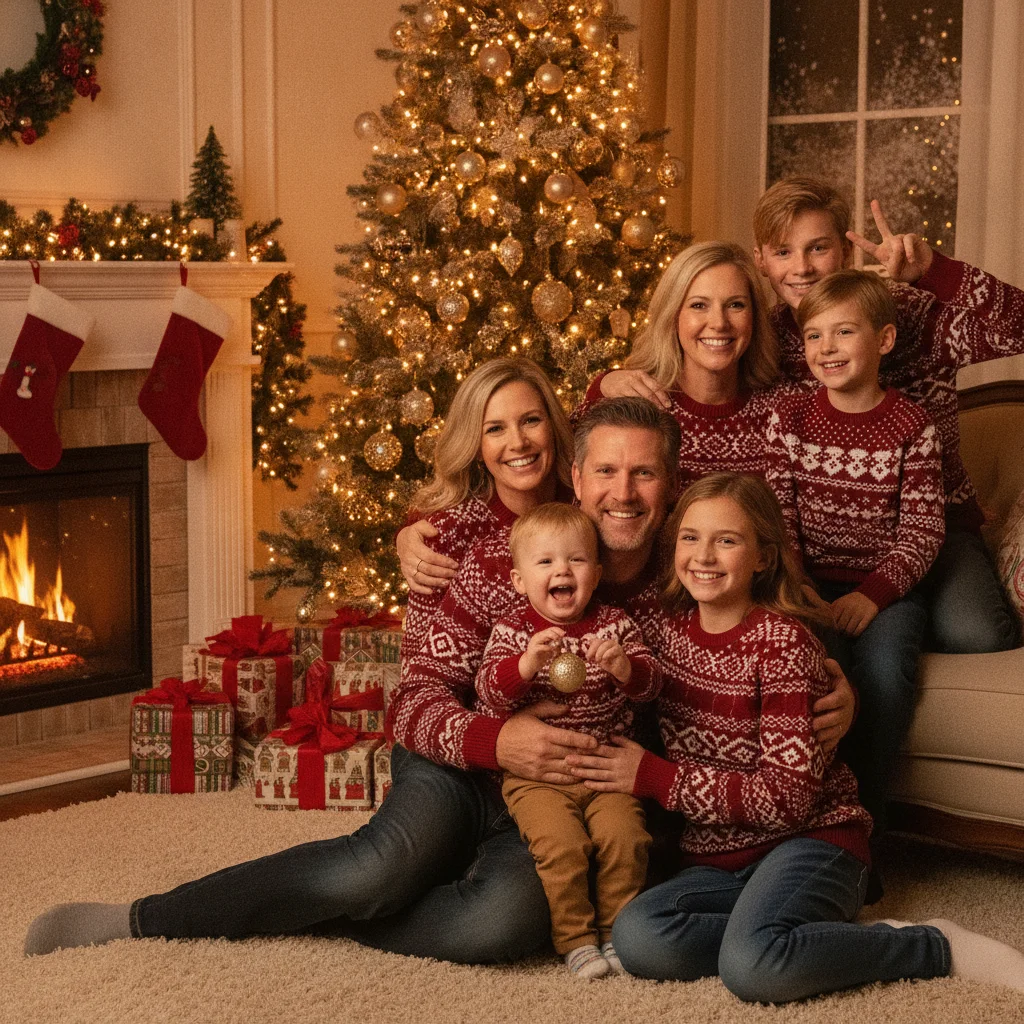
Quick answer: Pose a family for Christmas photos by placing adults first, arranging children close to the center, and keeping everyone’s faces at different heights. Turn bodies slightly toward one another, leave minimal gaps, and give hands a natural purpose. Capture a traditional smiling portrait first, then use simple prompts to create relaxed interactions and candid expressions.
A successful family Christmas photo should show connection without making every person look stiff or crowded. The easiest approach is to build the pose from the center outward, keep family members physically close, and vary head heights. Small adjustments to feet, shoulders, hands, and eye direction can turn a basic group picture into a polished holiday portrait.
How should you arrange a family for a Christmas photo?
Start by placing the parents, grandparents, or tallest adults. Position them near the center or use them as anchors on both sides of a seated group. Add children next, placing the youngest children close to a parent so they feel secure and remain easier to direct.
Create a compact shape rather than a straight line. A triangle arrangement works well because the tallest faces form the top and seated children form the lower points. Ask standing family members to turn their bodies about 30 to 45 degrees toward the middle while keeping their faces directed toward the camera.
- Choose the central seated or standing family members.
- Place the tallest adults around the center.
- Add children in front, beside a parent, or on a lap.
- Adjust everyone so faces appear at different heights.
- Close visible gaps between shoulders and bodies.
- Check hands, feet, clothing, and background distractions.
What family pose works best for a classic Christmas card?
A close, camera-facing pose is the safest choice for a traditional Christmas card. Seat one or two adults on a bench or sofa, place young children on laps or directly in front, and position older children beside or behind the adults. Everyone should lean slightly toward the center.
Take the formal portrait early, while clothing is tidy and children are attentive. Ask everyone to look at the camera and use a short countdown. Shoot several frames because blinking, shifting expressions, and wandering eyes are common in group portraits.
| Family size | Suggested arrangement | Useful pose |
|---|---|---|
| 3 to 4 people | Compact triangle | Parents angled inward with children centered |
| 5 to 7 people | Two staggered rows | Some seated and some standing behind |
| 8 or more people | Small family clusters | Each household grouped within one wide composition |
How can you make family poses look natural?
Give family members an action instead of repeatedly telling them to smile. Ask parents to look at their children, invite siblings to lean shoulders together, or have everyone look at the person most likely to laugh. These prompts create expressions that feel more personal than a fixed grin.
Movement also helps. A family can walk slowly toward the camera, cuddle under a blanket, decorate a tree, or share a gentle group hug. Keep the movement simple so faces remain visible and the composition does not fall apart.
Where should everyone put their hands?
Hands look natural when they have a clear purpose. Adults can place one hand in a pocket, rest a hand on a child’s shoulder, hold a partner’s hand, or wrap an arm around a family member. Seated people can rest hands loosely on their thighs or hold a young child.
Avoid stacking identical hand positions across the group. Ask family members to keep fingers relaxed and prevent clenched fists. If someone places a hand in a pocket, leaving the thumb visible usually looks more casual than hiding the entire hand.
How do you pose young children and babies?
Place babies securely in a parent’s arms or on a stable lap. Turn the baby slightly toward the camera while keeping the parent’s face close. Never use an unsupported prop or d surface solely to create a pose.
For toddlers, choose a spot rather than demanding a fixed posture. A toddler can sit on a small stool, stand between parents, hold a safe ornament, or cuddle a favorite toy. Photograph the child’s independent pose first, then bring the rest of the family into position around the child.
Use quick games to direct attention. Ask children to find something near the camera, whisper a silly word to a parent, or count down to a group hug. Keep each prompt brief and switch activities before children lose interest.
How should you pose a large or extended family?
Divide a large family into smaller household clusters while maintaining one overall shape. Place grandparents near the center, arrange adult children and partners around them, and position grandchildren in front. This structure makes relationships understandable without forcing everyone into one rigid row.
Use chairs, steps, or a gentle slope to vary height. Make sure every face has a clear line to the camera. A useful check is to ask each person whether they can see the camera lens, since blocked sight often means a blocked face.
What camera setup helps family poses look better?
Position the camera near the eye level of the group’s middle row. Leave enough space around the family for cropping, but avoid standing so far away that faces become insignificant. For phone photos, use the rear camera and a tripod or stable support when possible.
Use soft window light indoors or open shade outdoors. Avoid mixing strong indoor bulbs with daylight because skin tones may look inconsistent. Check that tree lights and decorations do not appear to grow from anyone’s head.
What are the limitations of posed family Christmas photos?
No single pose suits every family, body type, mobility need, or age group. Seated arrangements may be more comfortable for grandparents, pregnant family members, or people with disabilities. Adapt the pose around comfort rather than asking someone to hold a painful position.
Young children and pets may not look at the camera at the same moment. Treat those variations as part of the session and take multiple images. A photograph with genuine interaction can be stronger than one in which every posture is technically perfect.
The most reliable Christmas family pose combines close spacing, varied face heights, bodies angled toward the center, and relaxed hands. Capture one formal portrait first, then introduce movement and playful prompts for natural alternatives.
Which lighting and camera settings make family Christmas poses print-ready?
For posed family Christmas photos, use soft light, an aperture that keeps every face sharp, and a shutter speed fast enough to prevent movement blur. Place the family near a large window or use a diffused light aimed across the group rather than a bare flash pointed directly at them. For a single row, start near f/5.6; for staggered rows, use about f/8 and keep each person’s face within a similar focal plane. Choose at least 1/250 second when children are included, then raise ISO as needed instead of lowering the shutter speed. Focus on an eye in the middle row and check the back row at full magnification. For a 5-by-7-inch card at 300 DPI, retain at least 1500 by 2100 pixels after cropping (Vistaprint, 2026).
Frequently asked questions
What is the most flattering angle for a family Christmas photo?
Turn each person’s body slightly toward the center while keeping faces aimed at the camera. This creates connection and usually looks less rigid than placing every shoulder square to the lens.
Should family members stand or sit for Christmas photos?
A mix of seated and standing positions creates useful height variation. Seating also helps accommodate young children, grandparents, and family members with limited mobility.
How do you pose a family of four for Christmas pictures?
Arrange the family in a compact triangle, with parents angled inward and children between them or slightly in front. Keep heads at different heights and minimize gaps between shoulders.
What should family members do with their hands in photos?
Hands can hold another person, rest on a shoulder or thigh, or sit partly inside a pocket. Fingers should remain relaxed, and identical hand positions should be avoided.
How do you get children to smile naturally in Christmas photos?
Use short games, silly questions, movement, or prompts that encourage children to interact with their parents. Photograph several frames instead of asking children to hold one smile.
Should everyone wear matching clothes in a family Christmas photo?
Exact matching is not required. Coordinated colors and similar levels of formality usually create a cohesive result without making the family look uniform.
What aperture should I use for a family Christmas photo?
Use about f/5.6 for a compact family arranged in one row and around f/8 for two or more staggered rows. Avoid placing people far apart from front to back. After taking a test frame, enlarge the image and confirm that the nearest and farthest eyes are both sharp.
How do I avoid blurry faces in an indoor family Christmas photo?
Use a shutter speed of at least 1/250 second when children may move, stabilize the camera, and add soft light if the room is dim. Raise ISO before accepting a slower shutter speed. Ask everyone to hold still briefly, shoot a short burst, and inspect eyes and hands for motion blur.