
How to Photograph Kids Opening Christmas Presents
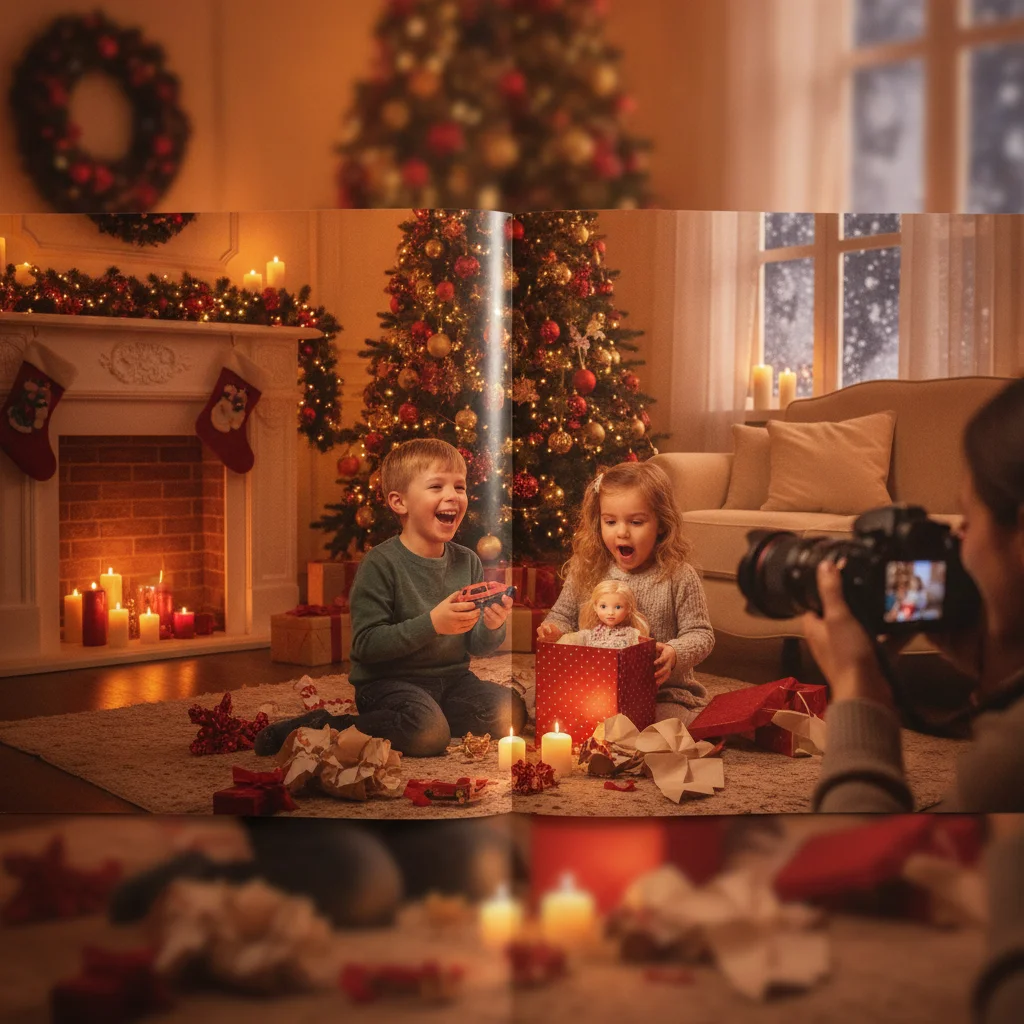
Quick answer: Use a fast shutter speed, continuous autofocus, and burst mode to photograph children opening Christmas presents. Position yourself near a window or turn on enough room lighting before the first gift is opened. Capture reactions as well as the presents, avoid interrupting the children, and alternate between wide scene-setting photos and close emotional moments.
How should you prepare the room before presents are opened?
Prepare the room before the children arrive so photography does not interrupt the celebration. Open curtains, switch on lamps, remove distracting packaging from the background, and check where adults will sit. Place yourself where you can see the children's faces rather than the backs of their heads.
Look at the direction of the available light. A child facing a window will usually be easier to photograph than a child sitting with a bright window behind them. If the Christmas tree is important to the scene, choose an angle that includes it without placing every child in deep shadow.
Take a few test photos using an adult or a wrapped present as the subject. Check brightness, color, focus, and shutter speed. This short test reduces the chance of discovering incorrect settings after the biggest reactions have passed.
Which camera settings work best for opening presents?
Children move quickly when they tear paper, turn toward relatives, or hold up a new toy. A shutter speed of at least 1/250 second is a useful starting point. Increase it to 1/500 second for very active children or flying wrapping paper.
Use continuous autofocus, called AF-C or AI Servo on many cameras, and select a tracking mode that recognizes faces or eyes. Turn on continuous shooting or burst mode, but use short bursts rather than holding the shutter button through the entire event.
| Situation | Suggested starting point |
|---|---|
| Bright room near windows | 1/500 sec, f/2.8 to f/4, Auto ISO |
| Typical indoor lighting | 1/250 sec, widest practical aperture, Auto ISO |
| Phone camera | Photo mode, exposure slightly reduced, Live Photo or motion photo on |
Higher ISO may add visible grain, but a sharp, expressive photo is usually more valuable than a cleaner image blurred by movement. If the camera offers a minimum shutter speed for Auto ISO, set it to 1/250 second or faster.
How can you photograph natural reactions?
Watch the child's face before the wrapping paper comes off. Anticipation, concentration, and the first glance at a present often create stronger photographs than a posed picture taken afterward. Keep the camera ready when someone reads a gift label or hands over a surprising package.
Avoid asking children to repeat reactions. Let them interact naturally with siblings, parents, and grandparents. Photograph the person giving the present too, especially when that person is watching for a response.
Stay at the child's eye level when possible. Kneeling or sitting on the floor makes the viewer feel part of the scene and prevents every image from looking down at the children.
Should you use flash for Christmas morning photos?
Direct flash can produce harsh shadows, bright foreheads, and a dark background. Available window light is often more flattering. If the room is too dark and you have a separate flash, point it toward a neutral white ceiling or wall to create softer bounced light.
Do not bounce flash from strongly colored surfaces because the reflected light can tint skin. Flash may also distract young children, so test it before gifts are opened and stop using it if anyone becomes uncomfortable.
How do you take better present-opening photos with a phone?
Clean the phone lens first because fingerprints soften detail and spread the glow from tree lights. Tap the child's face to set focus, then lower the exposure slightly if bright windows or lamps are washing out the image.
Use the main rear camera when practical because it generally performs better indoors than an ultrawide lens. Avoid digital zoom. Move closer without blocking other family members, or crop the image later.
Activate Live Photo, motion photo, or a similar feature if available. These modes can preserve frames immediately before and after the shutter press, which may help recover a better expression. For rapid action, hold the shutter control in the phone's burst mode.
Which moments and details should you capture?
Create a complete visual story rather than photographing only children holding gifts. Start with a wide view of the room before the wrapping begins. Add medium shots of each child opening a present and close photographs of hands, ribbons, gift tags, stockings, and discarded paper.
- Children waiting for the first present
- A gift giver watching the recipient
- Siblings helping each other with packaging
- The first reaction to a meaningful gift
- Hands assembling or testing a new toy
- A final wide photo of the room and family
Include quiet moments between the obvious reactions. A child reading a new book or sitting beside a grandparent can provide emotional balance to louder action photographs.
How can you avoid missing the most important shots?
Charge batteries, clear storage space, and place spare batteries or a power bank nearby. Use one dependable lens instead of changing lenses while presents are being opened. A standard zoom or a moderately wide phone camera covers most family rooms.
Ask the family to open one important gift at a time if that fits their tradition, but do not direct every movement. Choose a few priority moments and remain present for the celebration instead of viewing the entire morning through a screen.
The most reliable approach is to prepare the light, use a shutter speed of at least 1/250 second, focus on faces, and photograph short bursts around each reaction. Technical perfection matters less than preserving genuine expressions and family connections.
What limitations should you expect?
Indoor light levels vary, so no single setting works in every home. Fast movement may still blur in a dark room, while mixed window, lamp, and tree lighting can create uneven colors. Automatic face detection may also focus on the wrong person when several relatives overlap.
Some children dislike cameras or become overwhelmed during gift opening. Respect requests to stop, avoid publishing identifiable images without parental permission, and never allow photography to interfere with supervision around small parts, cords, candles, fireplaces, or unstable decorations.
What lighting and camera setup makes photos of kids opening Christmas presents print-ready?
For present-opening photos that hold up in print, place the child beside a window and use shutter-priority mode at about 1/320 second with Auto ISO and continuous autofocus. Turn on the room’s brightest neutral lights, but avoid mixing in strongly colored decorative bulbs near the child’s face. Lock white balance after everyone sits down so window light, tree lights, and warm lamps do not cause inconsistent skin tones. Set exposure compensation slightly below zero when reflective wrapping paper dominates the frame, then confirm that faces are not too dark. Capture images at the camera’s full resolution and leave enough space around hands, gifts, and expressions for cropping. A 5×7-inch image at 300 DPI requires 1500 × 2100 pixels (Vistaprint, 2026).
Why do present-opening photos fail differently at noon and after dark?
At noon, present-opening photos usually fail from excessive contrast; after dark, they fail from insufficient light and mixed color. Direct midday sun through a window can put one side of a child’s face in a bright patch while the Christmas tree and wrapping paper remain dark, so automatic exposure sacrifices either highlights or shadows. Move the opening area out of the sunbeam, turn faces toward indirect window light, and close sheer curtains to soften it. After dark, window light disappears, forcing slower shutter speeds or higher ISO while warm lamps and cool LEDs create uneven skin tones. Switch on several room lights with similar bulb colors, keep children near the brightest source, and use bounced flash if available. Noon favors diffusion and repositioning; after dark favors added, consistent light.
Frequently asked questions
What shutter speed should I use for children opening presents?
Start at 1/250 second and use 1/500 second for energetic movement. Raise ISO rather than accepting heavy motion blur.
How do I stop Christmas morning photos from looking blurry?
Use a faster shutter speed, continuous autofocus, and short bursts. Adding room light or moving the child closer to a window also helps.
Should I photograph present opening in RAW or JPEG?
RAW provides more flexibility for correcting exposure and mixed lighting. JPEG is suitable when you want smaller files and photos that are ready to share quickly.
What lens is best for photographing children indoors at Christmas?
A standard zoom or moderately wide lens works well in small rooms. A lens with an aperture around f/2.8 can help in low light, but accurate focus becomes more important.
How can I include Christmas tree lights without blurry children?
Expose for the child and maintain a shutter speed of at least 1/250 second. Tree lights will remain visible if the room is not made excessively bright.
Is burst mode useful when children open gifts?
Burst mode is useful for brief reactions, flying paper, and quick expressions. Short bursts make the final photo selection easier than recording continuously.
How many photos should I take during present opening?
Take enough to cover wide scenes, individual reactions, family interactions, and details. ChristmasCard recommends prioritizing meaningful moments rather than creating hundreds of nearly identical frames.
Why do faces look too dark when children open presents near the Christmas tree?
Faces look dark because the camera may expose for bright windows, tree lights, or reflective wrapping paper. Move the child so window light falls across the face, or raise exposure compensation slightly while watching highlight warnings. Meter from the child’s skin rather than the full room, especially when the background contains illuminated decorations.
How do I keep shiny wrapping paper from ruining present-opening photos?
Reduce glare by changing your shooting angle and keeping direct lamps from reflecting toward the camera. Use a small negative exposure adjustment if metallic paper creates clipped highlights, but check that the child’s face remains properly exposed. Photograph from slightly above or beside the gift rather than directly facing its reflective surface.
Is noon or after dark better for photographing children opening presents?
Noon is usually easier if the window light is indirect, while after dark can be more consistent when you control every lamp or flash. Avoid placing children in a direct sunbeam at midday. At night, add enough room light to preserve a fast shutter speed and use bulbs with similar color.