
How to Photograph Christmas Portraits by a Fireplace
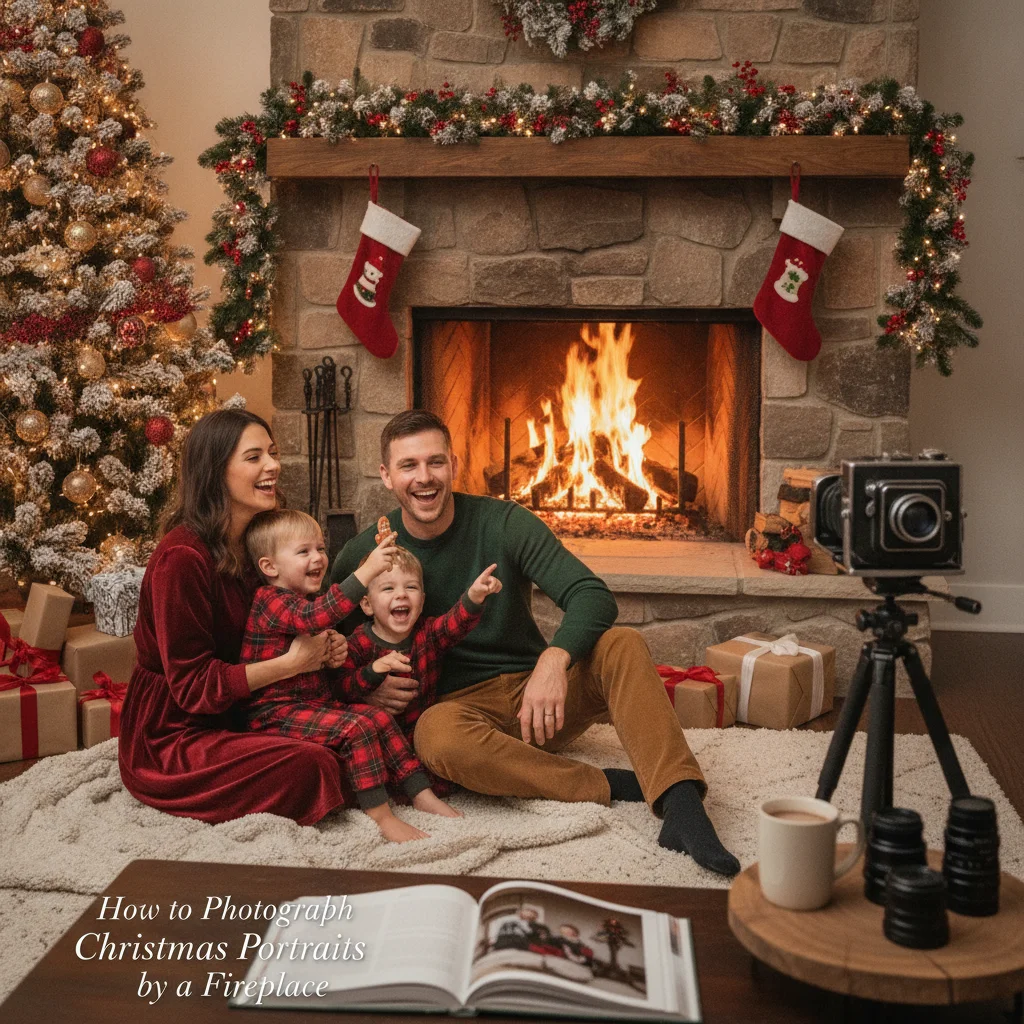
Quick answer: Photograph Christmas portraits by a fireplace by placing people several feet in front of the fire, adding a soft light near the camera, and exposing for faces rather than flames. Use a wide aperture, moderate shutter speed, and warm white balance. Keep clothing, props, children, and pets safely away from heat, sparks, and fireplace tools.
The best fireplace portraits preserve the warm glow of the flames without using the fire as the main light source. A soft lamp, window, flash, or LED light should illuminate the subjects’ faces while careful positioning keeps the scene natural and safe.
How should you prepare the fireplace and room?
Clean the visible hearth, fireplace screen, mantel, and surrounding floor before taking photographs. Dust, ash, electrical cords, remote controls, and unrelated household objects become distracting once the camera compresses the scene.
Use a restrained selection of decorations. A garland, stockings, candles that are not lit, and a small group of ornaments can establish a Christmas setting without competing with the people. Avoid placing combustible decorations close to an active flame.
Turn off harsh ceiling lights if they create deep eye sockets or mixed color casts. Keep practical lamps or Christmas lights on when they add depth to the background. Test decorative LEDs before the session because some lights produce visible bands at certain shutter speeds.
Where should people sit or stand?
Position people several feet in front of the fireplace rather than directly beside the opening. The exact distance depends on the fireplace design, heat output, and manufacturer guidance. A protective screen should remain in place whenever sparks or embers could escape.
Ask seated adults to turn their bodies slightly toward the center of the group. Faces should remain angled toward the camera or the primary light. Children can sit on a stable bench, low stool, or rug only when the surface is a safe distance from the fire.
Create separation between heads so every face remains visible. For a family, place taller people toward the back or outer edges and younger children near the center. Keep poses comfortable because rigid shoulders and forced head angles are especially obvious in close portraits.
What camera settings work for fireplace portraits?
Manual exposure gives the photographer consistent results as flames change brightness. Aperture priority can also work if exposure compensation is adjusted after reviewing the first few images.
| Setting | Suggested starting point | Purpose |
|---|---|---|
| Aperture | f/2.8 to f/4 for one person; f/4 to f/5.6 for groups | Keeps faces sharp while softening the room |
| Shutter speed | 1/125 second or faster | Reduces blur from normal movement |
| ISO | 800 to 3200 | Supports a usable shutter speed indoors |
| White balance | 3200K to 4200K | Retains warmth without making skin overly orange |
| Focus | Single-point or eye autofocus | Prioritizes the nearest important eye |
Use the camera’s histogram and highlight warning to check the flames. Small areas of clipped flame are usually acceptable, but faces should retain detail. Photograph in RAW format when possible so skin tone, shadows, and white balance can be adjusted with less image degradation.
How can you light faces without losing the firelight?
A fireplace usually produces uneven light from below, which can create dark eyes and an unnatural orange cast. Add a soft light near the camera and slightly above eye level. A shaded lamp, bounced flash, diffused speedlight, or adjustable LED panel can provide the needed illumination.
Set the added light to a low level and increase it gradually. The goal is to make faces clear while allowing the fireplace and Christmas lights to remain visible. Direct on-camera flash often makes the room look flat, so bounce the flash from a neutral wall or ceiling when possible.
If no additional light is available, place subjects where a nearby window can illuminate them. Schedule the portrait before sunset so the window contributes soft light without overpowering the fireplace.
How do you compose a natural Christmas portrait?
- Frame a wide establishing photograph that includes the mantel and decorations.
- Move closer for a group portrait from the waist up.
- Photograph individual expressions and interactions, such as reading, talking, or exchanging a wrapped gift.
- Capture a few vertical compositions for cards and mobile sharing.
- Leave open space around the group when text may be added later.
Use a focal length between about 35mm and 85mm on a full-frame camera, or the equivalent on another format. Wider lenses show more of the room but can distort faces near the frame edges. Longer lenses provide flattering compression but require more working distance.
How can you photograph children and pets safely?
An adult who is not taking the photograph should supervise young children and pets. The supervisor should remain close enough to intervene immediately, even if that person must be cropped from a test frame.
Do not ask a child to hold fireplace tools, touch the screen, add wood, or pose on the hearth. Avoid loose blankets, synthetic costumes, dangling scarves, and oversized sleeves near an active fire. Pets should remain under direct control and should never be tethered to fireplace furniture.
Prepare the pose before lighting a wood-burning fire when practical. A contained electric fireplace or an unlit decorated hearth can be a safer alternative, but cords, hot surfaces, and glass fronts still require attention.
What limitations should you expect?
Firelight changes constantly, so brightness and color will vary between frames. Mixed lighting from flames, lamps, windows, and decorative bulbs can also make accurate skin color difficult. RAW files provide more correction flexibility, but severe color casts may not disappear completely.
Small rooms can limit lens choice and camera distance. Reflective fireplace doors may show the photographer, light stands, or other parts of the room. Check reflections before the final photographs and shift the camera or lighting angle when necessary.
A real fire is not required for a convincing Christmas portrait. An unlit fireplace with warm room lighting may provide more predictable exposure, easier posing, and lower risk, especially during sessions involving babies, active children, or animals.
Which lighting and camera settings make fireplace Christmas portraits print-ready?
Use manual exposure, preserve color in the brightest flames, and add a soft, neutral light on faces to make fireplace Christmas portraits print-ready. Set the shutter speed for the people first, choose a moderately wide aperture, and raise ISO only as much as needed. Position the added light near the camera and slightly above eye level so it lifts facial shadows without flattening the fireplace glow. Check the histogram and highlight warning; small bright areas in the fire may clip, but skin and important decorations should retain detail. Capture RAW files so you can balance warm firelight against natural skin tones during editing. Crop only after correcting exposure and color. For a 5-by-7-inch card at 300 DPI, retain at least 1500 by 2100 pixels in the finished file (Vistaprint, 2026).
Frequently asked questions
Should the fireplace be lit for Christmas portraits?
A lit fireplace adds warm background light, but it is not essential. An unlit hearth can be safer and easier to expose, especially with children or pets.
What shutter speed should I use near a fireplace?
Start around 1/125 second for adults and use 1/200 second or faster for active children. Increase ISO or add soft light if the faster shutter speed makes faces too dark.
How do I stop faces from looking orange?
Add a neutral soft light near the camera and set white balance between roughly 3200K and 4200K. RAW capture allows more precise color adjustment during editing.
Can I use flash for a fireplace portrait?
Flash works best when bounced or diffused and set low enough to preserve the ambient glow. Direct flash can flatten faces and make the fireplace background appear dark.
Where should I focus in a family fireplace portrait?
Focus on the eye of the person closest to the camera, then use an aperture that keeps the other faces within the depth of field. Arrange faces at similar distances from the lens when possible.
What lens is best for indoor Christmas portraits?
A 35mm to 85mm full-frame equivalent lens suits most indoor portraits. Choose the wider end for the decorated room and the longer end for tighter, more flattering compositions.
How far should people sit from the fireplace?
People should remain several feet away or at the distance required by the fireplace manufacturer and local safety guidance. Heat output, fireplace type, screens, clothing, and decorations all affect the safe distance.
How do I keep fireplace flames from turning white in photos?
Lower the exposure until the main flames show yellow and orange detail rather than a solid white shape. Then brighten the people with a soft light instead of raising the overall exposure. Use the camera’s highlight warning to identify clipped areas, accepting that tiny flame tips may still appear white.
Why do my fireplace Christmas portraits look noisy when printed?
Noise usually becomes noticeable because the room was underexposed and the shadows were brightened heavily during editing. Add more soft light to the faces, expose skin correctly in camera, and avoid excessive shadow recovery. Gentle noise reduction can help, but preserve facial texture and check the final image at its intended card size.